Derwent River: A Short Walk with Mr Brown

Taroona to Brown’s River

Looking north towardsHinsby Beach from the Alum Cliffs track

I had an assignation with Mr Brown’s River and so it seemed quite appropriate to invite him to accompany me, if only in mind, on the cliff top walk above the Alum Cliffs one day late last year.
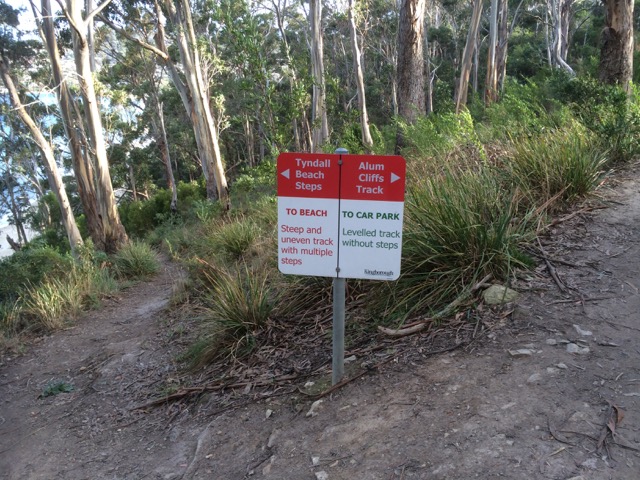
IMG_3494

That day I’d paused at the beginning of the track, surveying the view from a picnic table above the cliffs while chatting to locals, but mainly, I was quizzing Mr Brown, a drop out medical student from the University of Edinburgh who was thinking about all things floral while his fellow students focussed on cadavers, and whose enquiring mind and botanical obsession had, with a little help from Joseph Banks, brought him here aboard the Investigator in 1801, on Matthew Flinders expedition to discover whether New Holland was  one island or many.

There was a breeze, I was ostensibly alone and a single yacht had the white capped river to itself as it headed up river just like the Investigator, which spent some time in the D’Entrecasteaux and the Derwent. Accordingly, Robert Brown spent a lot of time collecting plant specimens from Table Mount (aka kunanyi / Mount Wellington) and along the river, encountering and following the course of Brown’s River in the process. These are my tramping grounds, but on the voyage out he’d visited another of my favourite haunts – Cape Town, where he climbed Table Mountain several times and enjoyed botanising in the fynbos and across the surroundings slopes, including Devil’s Peak.

Defeated by the boulders below the cliffs (see previous blog) it was a whole lot easier rambling along a well formed path that often felt more bushland than clifftop as it wove through eucalypts (silver peppermint and blue gum) and banksias, past epacris in bold red flower, with the companionable little sounds of small birds calling. It’s a sunny and shadowed path with a faintly minty fragrance in places, that occasionally deposits one at the cliff edge for filtered views across to Trywork and Gorringes Points and the long vista through the gap into Ralphs Bay as well as north and south along the river’s two shores. The Iron Pot was visible out towards Storm Bay. I had no doubt that samples of the plants I was walking amongst were included in the 3000 specimens my companion collected and that made their way back to the UK on the very damp Investigator. A conversation between Robert Brown and Charles Darwin, I decided, would have been interesting. They were both lateral thinkers with acute observational skills of the natural world, including geology who spent time here that led to new insights.

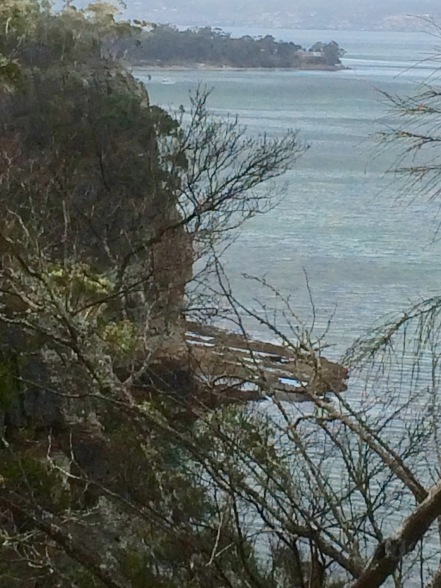
Perhaps this is the rocky platform you can reach from Taroona?
Rock platform below the cliffs

These cliffs, where Bonnet Hill abruptly meets the estuary, are unstable and prone to collapsing into the river along their fractures and faults. They’re siliceous and weather from their greenish-grey to a far paler white, patterned with hues of oranges and lemons. Sometimes oxides and pyrites stain their fractures and as they’re composed of Fern Tree Permian siltstone they occasionally bear fossils. I sauntered over all this rich geology not much thinking about it except to wonder, as I walked by the junction of the Brickfields Track, whether the alum they hold ever found its way into the tanneries that used to line the Hobart Rivulet and made it whiffy back in the early years of settlement. Robert Brown came from Edinburgh, that cold city of stone and so it’s not surprising that geological samples, the substrate on which plants grow, and which moss, a favourite plant of his, is prone to nibble, were among his samples too.

Crossing bridges

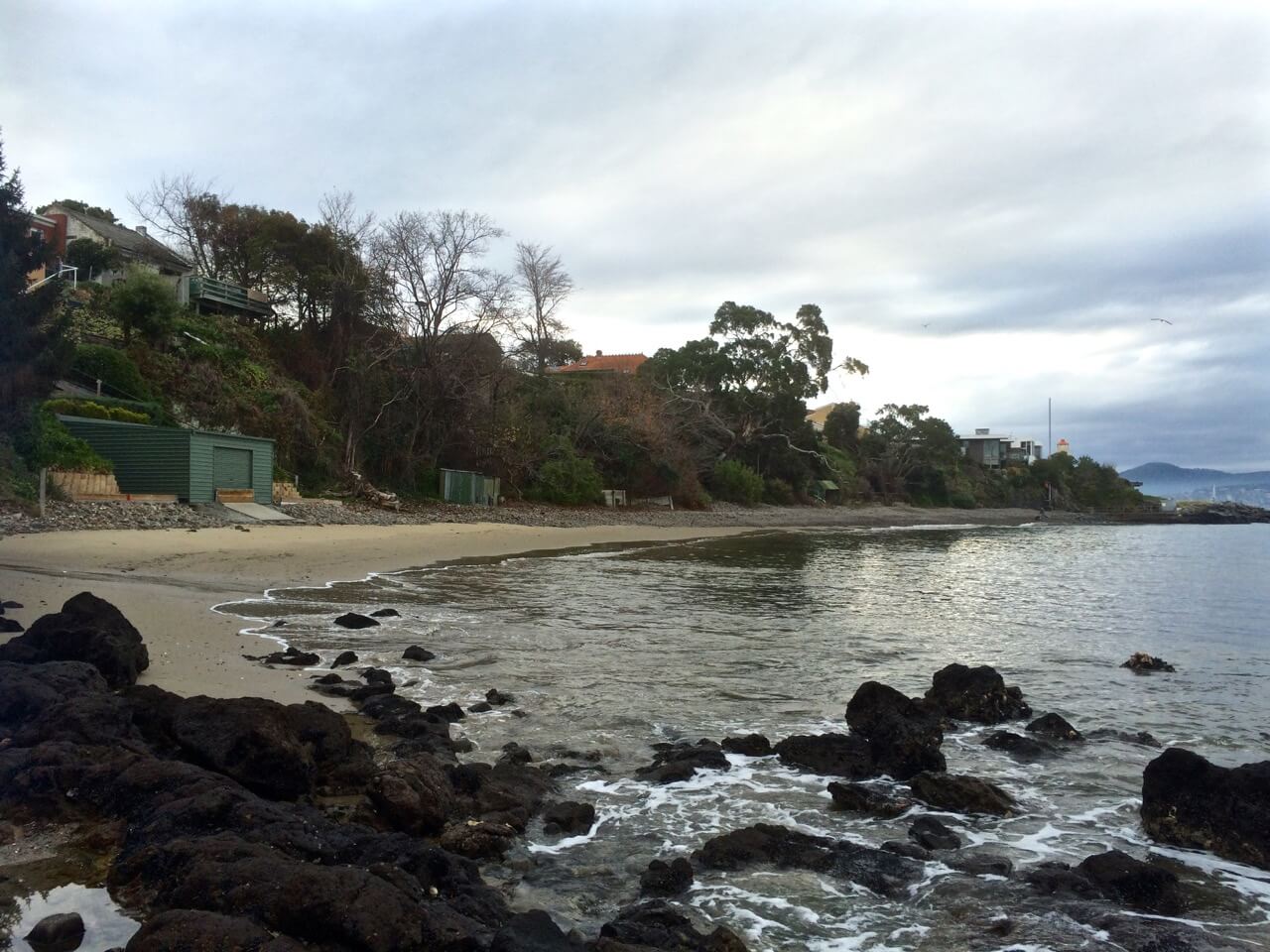
I crossed three small rivulets by way of wooden bridges and passed a few other people out walking that day but otherwise had the friendly solitude of the forest all to myself until, quite unexpectedly, I was out of the forest and crossing a broad and sunny expanse of grassy reserve with lovely views from the bench down to the beach where people walked their dogs oblivious to the fact that they were being observed from up on high. I clambered down the steep steps to the beach. I had left Taroona behind and was now in Kingston, originally known as the Brown River Settlement.

On Tyndall's Beach

Brown’s River, or Promenalinah, as it was named by the Aborigines who enjoyed its bounty before their lives were rudely disrupted, divides Kingston Beach into two shifting halves and although it’s really a single beach the northern section that has gone to the dogs in the best possible way (although shorebirds would disagree), is known as Tyndall Beach. This section is  continuously shape shifting in the most beautiful way. There’s a small cove in the northernmost corner tucked behind a lovely rock formation, it is fringed by vegetation and eucalypts as opposed to the houses and shops along the main beach but we walk it with a heavy footstep and so there are few shorebirds.
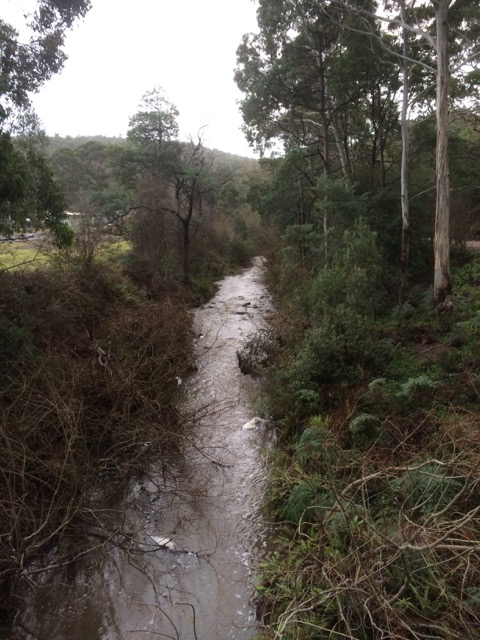
Brown's River
Brown’s River (upstream)

Tyndalls Beach looking northTyndall Beach looking north

After  lingering at the cove, I chose the narrow path that winds through the strip of vegetation at the foot of the cliffs in deference to my companion. A fair number of his new discoveries from this area turned out to have been discovered already by La Billardière on D’Entrecasteaux’s 1792 expedition. The two men didn’t just have botany in common. Conversely, La Billardiere started off with botany but later qualified in medicine.

I crossed the casual parking area between park and beach. Time was against me but the northwesterly was due to swing south westerly so at least I’d have the wind at my back on the return walk. And so there I paused on the footbridge over Mr Brown’s River contemplating both it and the floodplain it has carved between Bonnet Hill and Boronia Point. The tannin in the river makes it whisky coloured. It rises on kunanyi and I’ve followed much of its course, from above Silver Falls, down to the estuary. It runs narrow and free down the slopes (although some of its water is detoured into Hobart’s water supply) and then it weaves through its floodplain.

Robert Brown found the river when Aborigines still camped here and enjoyed the river’s largess and the hunting to be had behind the beach. There’s still a remnant wetland and there’s still the remnant bush I’d walked through, but my eyes took in an urban landscape – houses smothering the floodplain, and houses on the surrounding hills with their gobsmacking views.  Looking down from the Channel Highway, the clubhouse of the golfcourse is the Red House built by John Lucas way back when.  He was a a member of the first settler family to acquire land here.  They picked up several hundred acres of land around Brown’s River and it’s on this land that, in about 1808, Kingston began to take shape.  (For a historical perspective see the photos below).  He found other things to, being the first person to describe a living cell nucleus and observing the tiny random movements of miniature particles down his microscope.  You learned about this in Biology.  It’s named after him – Brownian motion.

I retraced my steps, trailing my companion but mingling with modern day locals using the track. With the arrival of the south westerly the river grew wilder and the forest canopy transformed into an orchestra of wind instruments. I hoped the trees would hold.

I once took a walk  in Eastern Turkey with a friend. That path was the only link between two villages. It crossed a shallow river that my friend traversed on a donkey.  There were   caves where hermits had once meditated; the way we were walking was thousands of years old. The Alum Cliff track links Taroona and Kingston but it is purely recreational. It’s quite possible that Aboriginal feet originally made it but I don’t know this to be a fact. Even though these days the purpose of footpaths has diminished, in the same way that arriving at an anchorage by boat is so different in feeling from arriving by car, so is it different arriving at a well known destination by foot.

There are at least two suburban developments in Hobart that would have thrown Robert Brown into an apoplectic fit behind his desk in Joseph Banks’s library (he became its librarian). One is Tolmans Hill, completely natural not that long ago. The profound shock when the first house appeared up there! The dismay as the suburb grew. The other is the small enclave above Tyndall Beach that doesn’t really belong anywhere but has further eroded the landscape Robert Brown found so rich and strange. This used to be native bush but subdivisions continue to happen on Bonnet Hill and in the fullness of time the land still open land looks set to disappear.

Historic Photos of Brown’s River (Source: LINC Tasmania)

With Mount Wellington in the background

The Red House, cleared land and jetty

Bridge across the river

Brown’s River: looking across the river to Boronia Point

Entrance to Brown’s River (Mary Morton Allport)

Further Reading:
Leaman, David. 1999. Walk into history in Southern Tasmania. Lehman Geophysics, Hobart
Brown’s River History Group
Kingborough Council website
Australian Dictionary of Biography

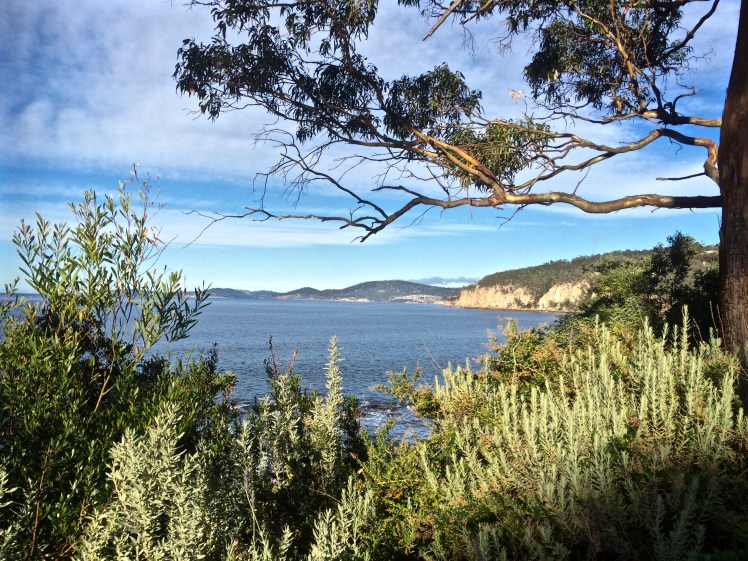
Derwent River: Alum Cliffs

No Business of Yours

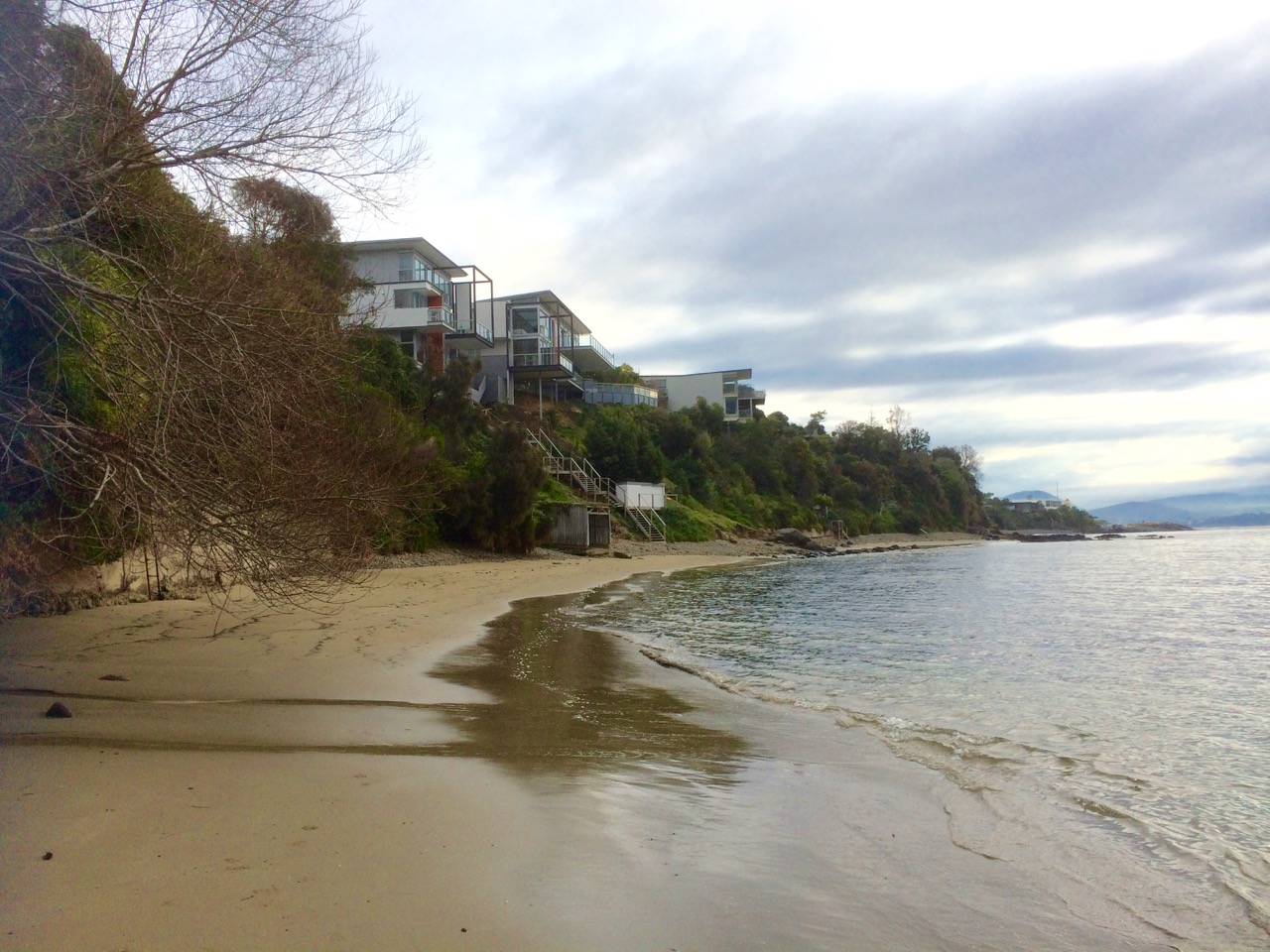
They were mine for paddling, and kayak along these cliffs I did, before discovering sailing and long before embarking on this humble little project.  Now, standing on Hinsby Beach gazing south along their tall and shadowed extent, I wondered about the possibility of actually walking along their base.  I’d once assumed the Alum Cliff track that begins at the bottom of Taronga Road  on Bonnet Hill was the only way.  Now I was not so sure.

Alum Cliffs
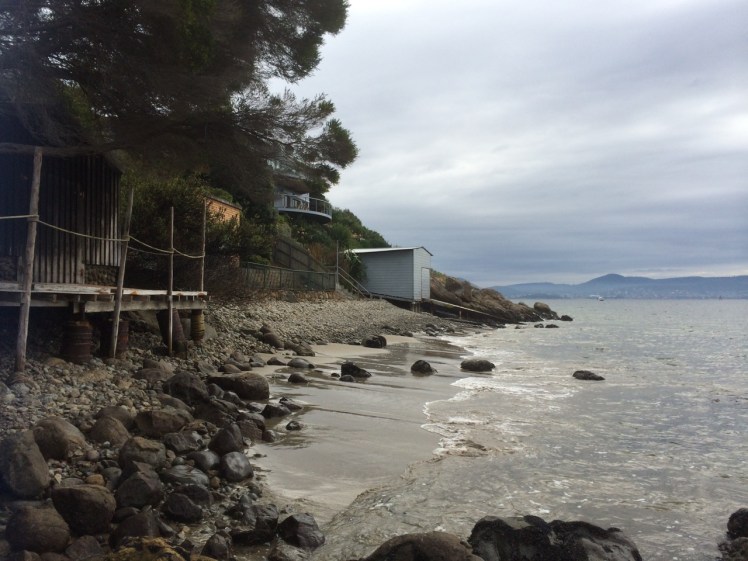
Alum Cliffs from the path above Hinsby Beach

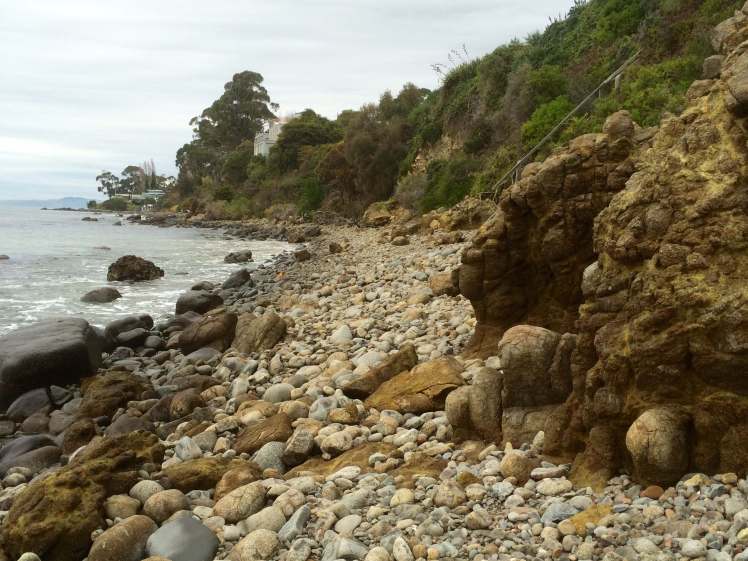
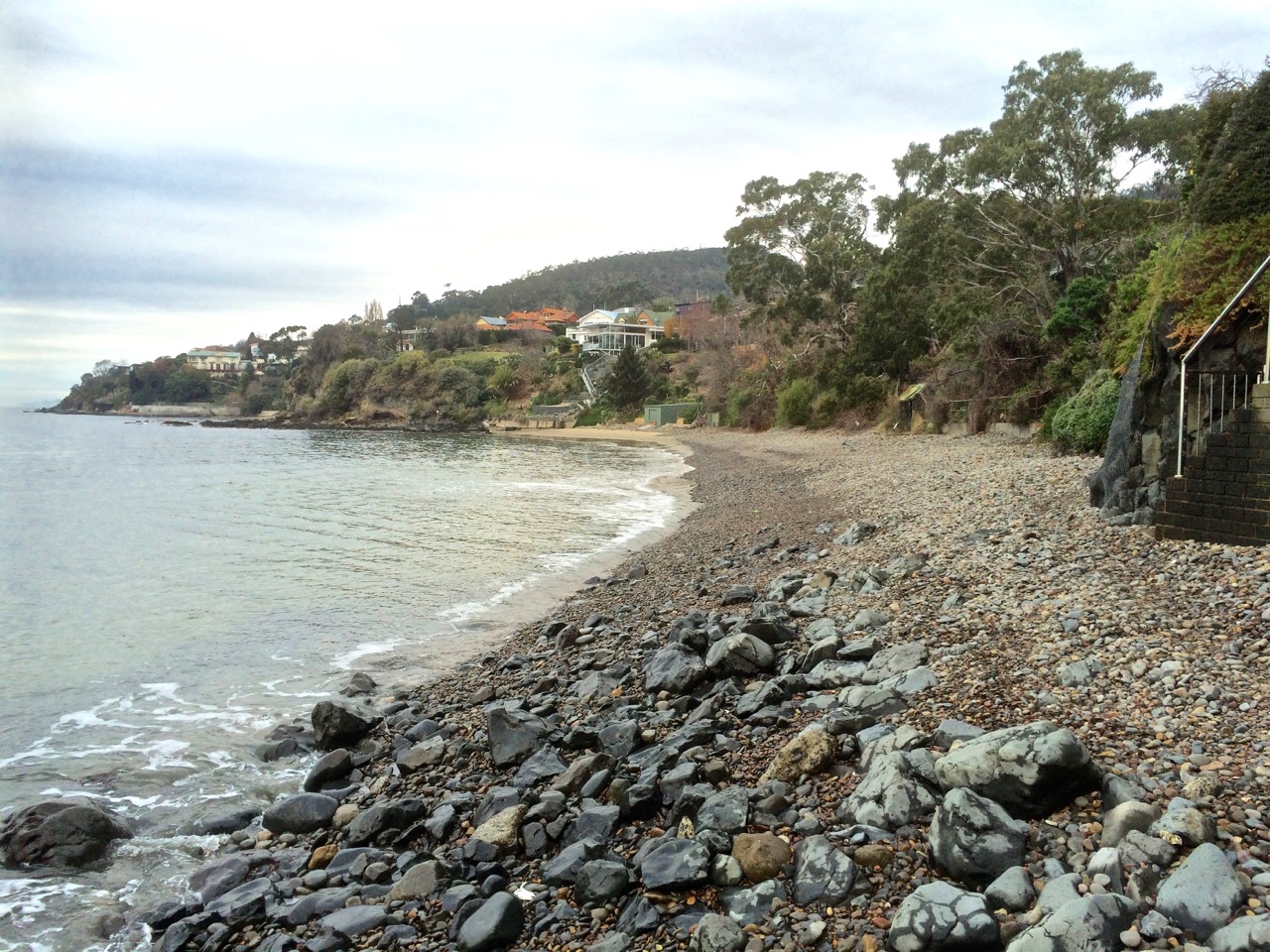
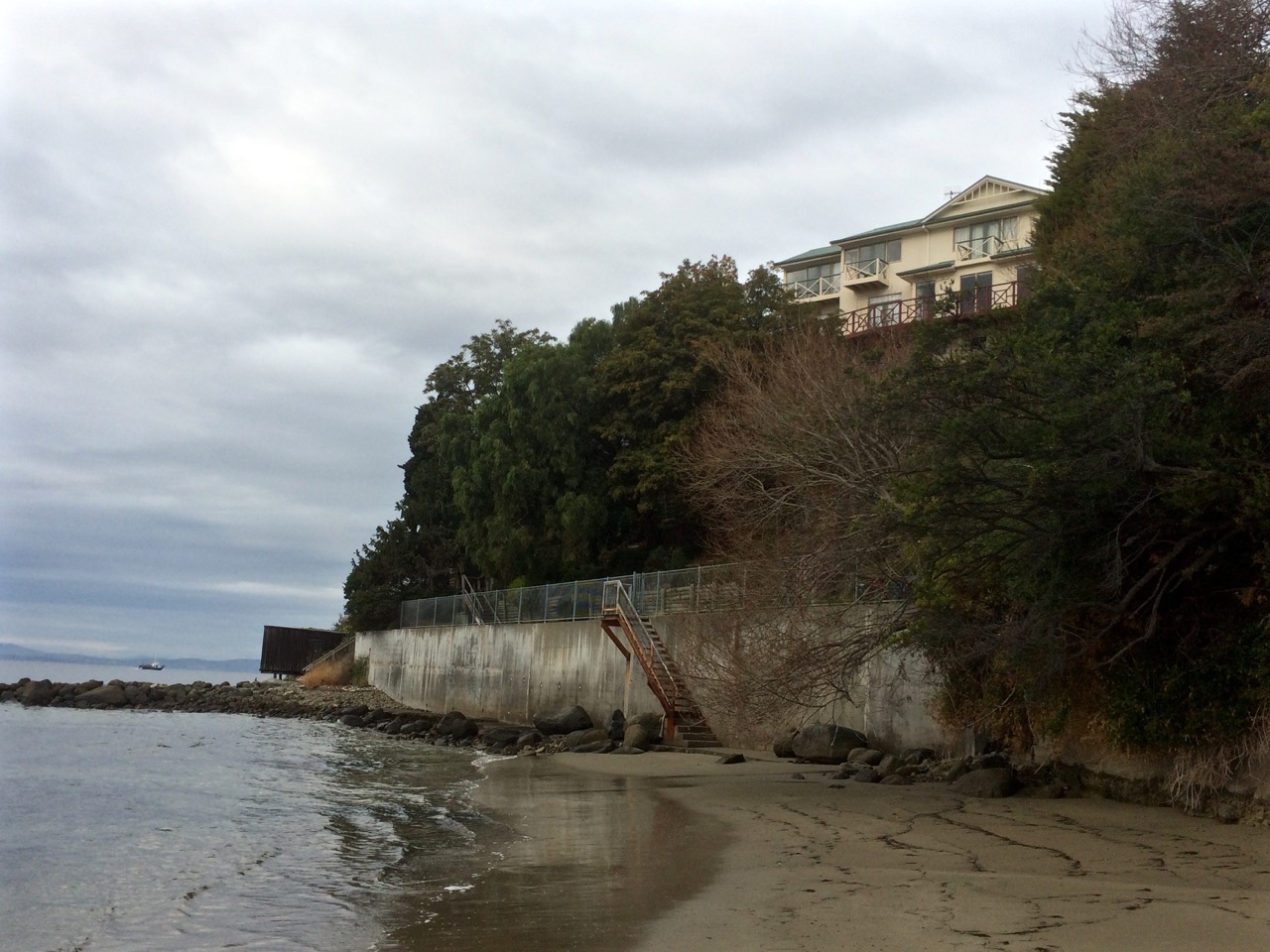
The coastline south from Hinsby Beach to Kingston  is  known as Alum Cliffs; the hill’s abrupt and perpendicular descent into the river.  There is no beach at its feet, just rocks and boulders, as well as a rocky platform containing fossils beneath Taronga Road (a cul de sac that runs from the Channel Highway down to the edge of the cliffs  not too far north of the point where the highway – in reality a narrow semi rural road – begins descending down to Kingston Beach).

Perhaps this is the rocky platform you can reach from Taroona?
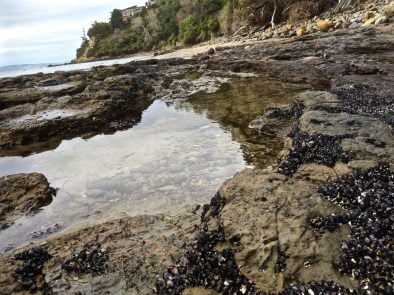
Rocky platform, Alum Cliffs

I knew about this fossilised platform from chats with locals on Hinsby Beach and from Sue Mount’s article.  They said that once it was possible to reach it on foot  but a local landholder had built a fence that now excluded the public.  Did they mean from their beach, or, in hindsight, did they misunderstand me and mean from Taronga Road?  Exactly how you accessed this platform wasn’t too clear but I was determined to try.

Many years ago, when I was deeply into archaeology I walked the Brickfields Track (also accessed on Bonnet Hill) with the Tasmanian Archaeology Society.  The Taronga Road area has mudstone, dolerite and a patch of quality sandstone along its ridge and is strewn with evidence of early colonial activities.

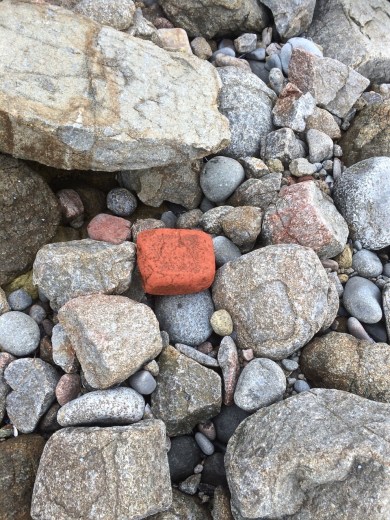
On that walk we came across remnants of the Brown’s River Probation Station (1840s) where over three hundred predominantly road building convicts once lived.  There were the remains of a kiln used for brickmaking.  Bits of the station are scattered through local gardens now and there’s a house with a  swimming pool built into the old quarry. As the years have unfolded some of the bricks once part of structures or left lying about have been removed and incorporated into new structures or lost altogether.  Some have no doubt ended up in the river.  On my earlier walks I’d encounter red bricks remoulded into satisfyingly round and textured shapes by water.

On the Channel Highway, close to Taronga Road, there is still evidence of an old convict built wall.  Some of that high quality sandstone (by Tasmanian standards) from the Taronga Ridge became the Shot Tower, locally famous for being the last remaining circular standstone shot tower in the world, built in 1870, almost twenty years after the probation station had become redundant.  It, too, eventually became redundant but in its heyday was used for producing lead shot.

Kayaking, you can get much closer to the cliffs than when you’re on a yacht, although it can be unpleasant when the waves rebound strongly off them.  On a yacht it’s best to leave a little seaway, especially along a lee shore, and when I pass by Alum Cliffs these days I’m usually sailing, observing these dark cliffs rising from the water, more wildness in the city precincts, topped as they are by communities of trees and shrubs forming a satisfying stretch of bushland.

There was a strong north westerly wind blowing on the first day I first set off to uncover a route along the cliffs from Taroona itself and I was feeling uncharacteristically despondent, in need of an activity to blast that mood away.  Sue Mount’s article  seemed to be a hint that the Alum Cliffs track had once started at the right of way onto the beach at lllawong Crescent.  I’d looked at other brochures and I’d looked on Google Maps.  None of them show it starting at this point.

But still I searched.  I returned to the start of the Hinsby Beach track at Wendell Crescent.  I walked down it and saw that there was in fact a path to the right that went along the very edge of the cliff, somewhat steep and slippery.  I got as far as a patch of escaped daisies from the garden above.  They were growing over the track and to proceed I had to grab hold of vegetation to pull myself upward.  It wasn’t clear that the path continued on the other side so I decided that as I was alone and the path a tenuous, unused one so hazardously close to the edge, I’d best go up to Taronga Road and see if I could meet up with it by heading north.

I was enthused by the discovery that I could indeed head north to Taroona on the Alum Cliff track but I  was not far along it when I met a local walking her dog, one like  Ash, and so we got talking.  She confirmed what I had already learned: that once it had been possible to take a path down to a large rock platform at the base of the cliffs hereabout and continue along towards Taroona, but it had been closed off by a landowner.  If I continued along this path I’d reach the Shot Tower.

‘And it’s steep,’ said a man I encountered a little further along, and he was right.  I came to a point where I had a clear view of the path heading downhill and then up the other side.  My focus is on beaches and the stretches of coastline between them, and with these beaches it’s on the river itself, particularly (but not only) where it interfaces the land.

I declined the path’s feeble invitation and turned back.

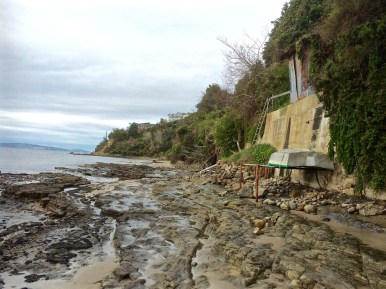
On the rocks below Alum Cliffs

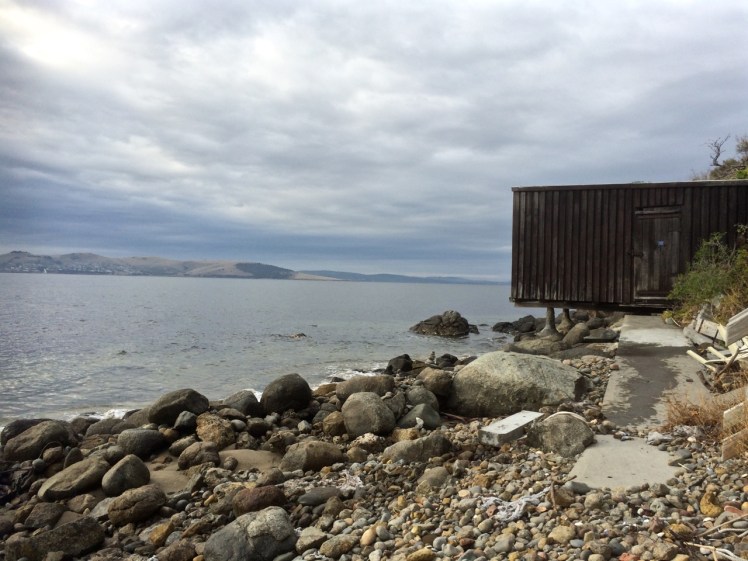
This was back in June 2015.  Since then, I’ve gone back to Hinsby Beach on five or six separate occasions, all on the most promising of low tides, sometimes in winter but also at the supermoon’s low last month (9 March), when, unfortunately, the seabreeze worked against me, hurling waves at my knees in a quite malicious fashion as I tried to negotiate a watery gap in the rocks close – very close, I feel – to the little turn the cliffs take as they head to the area beneath Taronga Road.  You’ve no business to be here, I felt they were saying. You people have made your track, now walk it.

But that day beneath the supermoon, I sat for a long time enjoying my splendid isolation, looking back towards Hinsby Beach, marvelling at seeing the cliffs with so much more of their base exposed, and enjoying their powerful presence at my back.  They are not the only cliffs in the world.  They are not even spectacularly tall but all the silence of the ages they contain gives them an undeniable aura in which I basked while deciding that, feeling personally rejected by the cliffs and the river, reaching the rocky platform and climbing up to Taronga Road wasn’t going to happen.  The track above the cliffs is there for a purpose, I could only agree, and it affords a different vantage point from my watery stamping grounds.  I decided with regret that I’d be satisfied with that.

And so that walk along the top of the Alum Cliffs from Taroona to Kingston is the subject of my next entry.

Sailing: The Wind that Builds the Beaches Floats my Boat

Like Birds on the Breeze

Sailing Samos
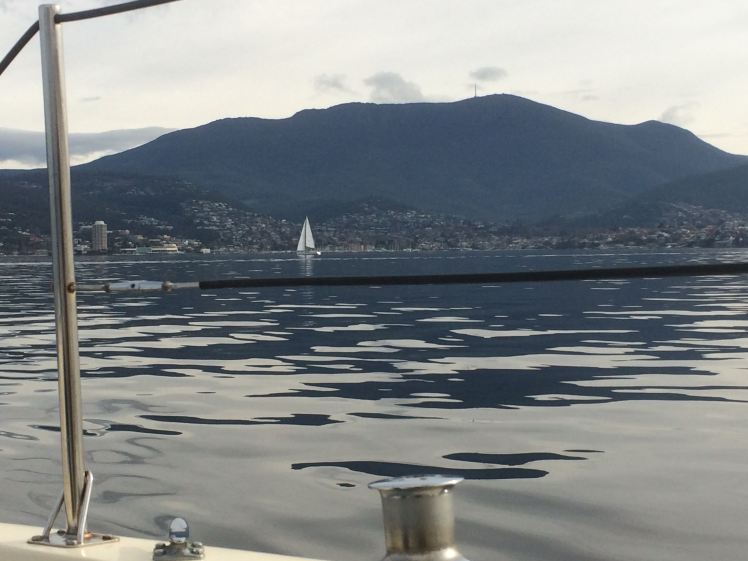
Sailing Samos in a light following breeze


Several years ago I went on a weekend course to learn to sail. There were four teachers: the skipper, the yacht, the wind and the river. I made some good friends and the wind, which until then I’d abhorred, was one of them. ‘Learn to feel it on your face,’ the skipper said and I realised that the wind was really a stranger to me, in part because I struggled to tell west from south and north from east.  The wind also presented a very different personality depending on what quarter it emerged from.

If it blew from one direction it blew consistently, right? But no. Focus on it against your face and you’ll see how much it flickers around, how much its strength can vary. A prevailing wind is not a single tone; there are plenty of other notes in there too and there’s no better guide than the windvane (aka masthead fly). When you sail you spend a lot of time looking up because the wind on your face and the wind at the top of the mast might well be behaving differently.

I learned that what the wind is doing above the Tasman Bridge might be different from what’s happening further down the estuary. It messes with the northerlies rampaging down (and vice versa the southerlies heading up). Betsy Island, the South Arm Peninsula and the Eastern Shore contrive to block the south easterly but wind spills in through the valleys. I learned from the geo that landforms can bend and twist the wind, spread it, funnel it (North West Bay is notorious) spin it, like in Sullivans Cove, deflect it, like at Sandy Point, block it as does Pierson’s Point so that suddenly the sails flap and you’re pooling around in a wind shadow.

There are the winds caused by the big weather systems, like the prevailing westerlies  that cycle eastwards in these middle latitudes and then there are more local winds like the sea breeze that arrives in the afternoon on those summer days when the island has warmed enough, and it sometimes arrives gently but often it barges in with its muscles flexed. It may stall for a while at the entrance to the Derwent – you watch that dark blue line of indecision, and then the wind rushing across the water towards you, it’s speed and power influenced by the ‘fetch’ as it begins to fill in and in so doing it might ‘knock’ you inconveniently or give you a ‘lift’ to where you are headed.  One thing is for sure, on the Derwent the wind takes a different guise diurnally, a different speed depending on where it happens to be (stronger in the wider zones, milder in sheltered bays) and it differs depending on the season.  Katabatic winds prevail, blowing in from the NW and the temperature inversion that takes place as wintery cold air sinks to the valley floor gives rise to the Bridgewater Jerry  that moves magnificently south down the river, a beautiful white snake of a cloud, its belly down low on the water and awfully cold to be stuck in.

You and your yacht become that pivot point between the wind and the water, their dance made manifest. You learn to read the wind in the water. It might be barely perceptible where you are, about Force 4 on the Beaufort scale for instance, but further away those yachts all heeled over to starboard? The wind is coming your way and it means business. And so you reef because two of the arts of sailing are observational skills and, as my partner on Birngana’s big mainsail used to say ‘Anticipation’.

There are other skills to be learned by the wind out on the Derwent. There’s patience when it deserts you and there’s staying grounded when it thrashes you, so that you’re all heeled over, hanging on and staring directly down into the water, the boom dragging through it, the headsail ripped, the person on the winch knee deep in the river coming over the coaming.

True wind is the wind au naturel. Apparent wind is when the wind made by motion combines  with true wind to change its angle and speed. The more you speed up, the more the apparent wind slips ahead of you, streaming through the ‘slot’ between your mainsail and your headsail and powers you along.  In effect, it’s your yacht’s most local wind.

When you’re close hauled and the wind is strong, the sails in tight, it’s a bouncy ride, sometimes tense, maybe exhilarating and then when you come about and the wind slips behind you, you can spread your sails out wide, kick back and relax, and the breeze that seemed to have it in for you when you were up against it, becomes a friendly zephyr following behind you. Yet it’s the same breeze and the way you experience it depends on the way you approach it – much like life.

By the same token, it’s easy to let your defences down and wonder why others have their life jackets on when you’re reaching for your bikini because its glassy out there and your boat is going nowhere. But it could be into a vacuum like this that the south westerly roars, attempting to break its own speed record, taking you and the Met Bureau unawares.

Glassy conditions on the Derwent
Glassy conditions on the Derwent: barely a  breeze

The wind lifts sand from dunes and spreads it along beaches. It might take from one beach and deposit elsewhere. It may work with a high tide to push waves harder and higher up dunes and cliffs, or it may lose its territorial battle and be shoved aside by an opposing, more powerful wind from another quarter.

The interplay is dynamic and affects you whether you’re walking, kayaking, cycling or sailing and the Derwent is a brilliant playground to learn all about it’s subtle idiosyncrasies and its full and merciless fury.  While conscious of the wind that fills the sail there are other breezes far higher in the atmosphere that pass overhead unregistered. Aeolian drift in the highest reaches carries tiny beings – small spiders, for instance – as well as seeds over vast intercontinental and oceanic distances, making a mockery of quarantine services. And out on the ocean birds, like sailors, yearn for a favourable wind to support their trip or exhausted from flying head on into stormy conditions, might hitch a ride on a yacht, trying to regain the strength to carry on.

On the river in the bleakest of weathers, the world becomes magical, the rain in one’s face exhilarating, the shoreline intoxicating as powered by that beach making and breaking wind we make our way.

Sea breeze coming in
Wind over water (Ralphs Bay)


Derwent River: Up Against It

The Birds And the Beaches

Last October I was at Eumarrah, Hobart’s oldest wholefoods shop, when I bumped into an acquaintance I hadn’t seen in quite a while. It so happens that we are both interested in the environment, and birds in particular have been a long and avid interest of his.

I was keen to find out his take on my observation of low bird numbers around the Derwent’s shores, be they on the western or eastern side or in Ralphs Bay, that beautiful low energy embayment near the mouth of the Derwent, these being some of my current stomping grounds. I had also walked ocean beaches with this concern uppermost in my mind and actually, it was while writing this now in my little mountain study, that it dawned on me that  there used to be a flock of seagulls that flew over our ridge en route from North West Bay (we used to assume) to the tip in South Hobart. ‘ When had this stopped?’  I asked the geo. ‘The sight and sound of them used to be part of the daily rhythm up here.’

‘I reckon they stopped flying over about two years ago,’ he said.

Two years for us to notice a pretty obvious change in our environment.  That’s sobering.  The only large flock I’ve seen since I started my walks has been at the dirty little mouth of New Town rivulet but perhaps I have not been focussing on gulls sufficiently because today, sailing Samos into Sullivans Cove just as the cold front arrived with a blast, I noticed a fair number perched on the roof of the new Institute of Marine and Antarctic Studies building and there was also a small flock at the Wrest Point casino.

It’s easy to assume that these birds, long considered the rats of the sea, are safe from our abuse of the environment… but what if something sinister is going on right under our noses that we are not aware of? And what if the seagulls are not as robust as we once thought? Of course, there could be some perfectly simple explanation. Down at the tip they might have introduced a management practice to stop scavenging seagulls from spreading toxic debris along the shorelines. Certainly, some councils have waged war on them (see links below).

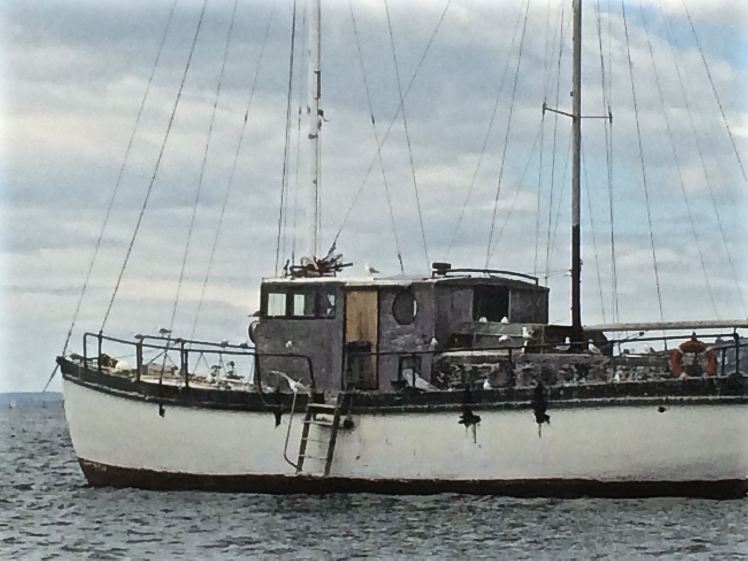
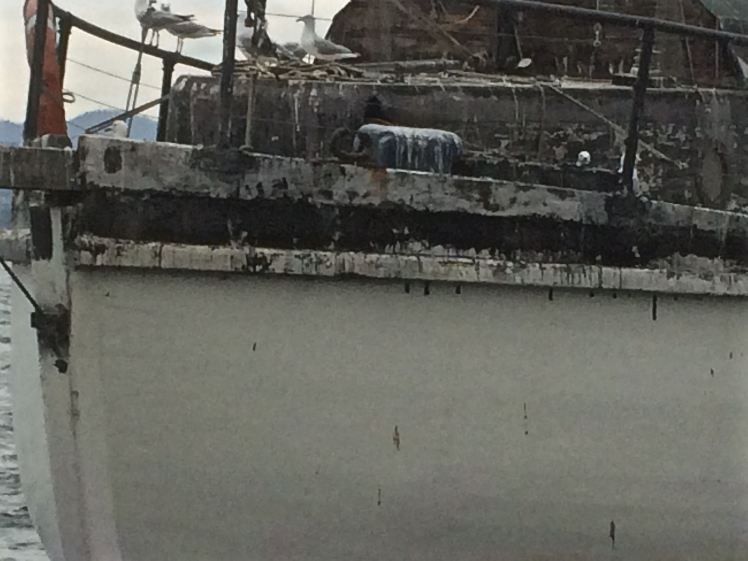
Gulls and cormorants are also regarded with trepidation by those sailors who have boats on moorings. I have a couple of friends who have been most unhappy to discover a seagull after party mess on their yachts.  Some people resort to nautical scarecrows, profiles of eagles, plastic bags and webbing. Take your eye off your yacht and this is what happens.

Seagull Central
Seagull central: it’s our palace now


Seagull payback

Anyway, this man so knowledgeable about all things avian, was kind enough to let me record our talk and so here are some of the points he made during the course of our long conversation.

Shorebirds are in decline. Some natural causes include high tides washing away nests. When you think about the more volatile oceans and weather we’re getting with climate change and the way dunes are being hammered by sea level rise, this would be headline news if birds like little penguins and short tailed shearwaters produced newspapers. Native fauna like quolls prey on birds too.

I could add my own examples: go out to Chappel Island in the Furneaux Group off Tasmania’s north eastern coastline and you can barely put one careful foot in front of the other without stepping on the snakes that prey on the short tailed shearwaters that have their southern summer burrows there.

He cited more examples and based on what he had to say I suggest we all go and peer at ourselves in the mirror because the main cause is our lack of restraint in the way we behave around beaches.  Some locals  walk straight through the plastic fences that councils erect on dunes to safeguard both nesting birds and eroding dunes. People camp on beaches, dunes, or just behind them. Radios blare, kids race about on quad bikes and dirt bikes. Adults in four wheel drive vehicles mistake dunes for playthings, crush nests and mess with the role of dunes as a barricade against the sea.

‘When this sort of thing is happening on remote ocean beaches,’ he said. ‘You know there’s no haven.’ And he mentioned a researcher dissecting a bird on Lord Howe Island, (a tiny speck in the ocean 600 km off the Australian coastline) and finding it chock full of plastics.

‘ And over fishing, acidification of the oceans, the warming seas,’ I said.

‘Dogs,’ he said. ‘Horses on beaches.’

‘Seven Mile Beach,’ I said.

‘Marion Bay Narrows,’ he added.

He had begun talking about birds, like oyster catchers and the endangered hooded plover that choose to nest in the tiny scrapes they make in soft sand. Instead of limiting themselves to the hard sand close to the watermark, people and their dogs trample all over the beaches. It’s possible to stamp on a nest oblivious to what you are doing. ‘You may think your dog is doing no damage, but these nests are hard to see.’ And dogs, he emphasised, run all over the beaches. ‘It’s bad enough when they’re leashed. They still scare birds away.’

He told me about the annual gull count that is run over the June long weekend and includes the Derwent River.  On Bellerive Beach, for example, ‘there’s a veritable passeggiato of dogs and their owners and so there’s no chance for a bird to make use of it’, he said.

I began to feel uneasy.  I have two beautiful canine companions, fellow adventurers where their presence is allowed. I thought of all our lovely beach walks. It seems to me that even people walking quietly and carefully down a beach with no dog at all disturb birds and even scientists monitoring or researching bird behaviour and lifestyles have that same effect no matter how careful they try to be. Birds nestled over their eggs leave their nests, for instance, when they see that most dangerous of all mammals (us) looming, albeit with a scientific title. But mostly I was thinking about the consequences for me in raising my awareness about this issue. My dogs! The beach! Were they two incompatible loves? And what was more important? Shorebirds, or the delight of seeing my happy dogs enjoying the surf?

‘And boats too,’ I said with a heavy heart.

‘Yes,’ he said. And he told me about a particular reserve on the Derwent River, a little one, just a handful of hectares. He’d recently gone there to do a survey and he explained how its done. You spend twenty minutes on each hectare noting the birds you see and hear. ‘That’s how the atlas [Bird Atlas of Australia] was done, right across Australia. But in those twenty minutes there was a jet ski out on the river in front of me, jets from the display squadron from the RAAF – two went up the river, a helicopter going up the river, a fixed wing aircraft directly overhead at low altitude, there was big earthmoving equipment on a block just up the road from me and somebody was using a brush cutter the whole time I was there. So how am I to rely on my ears to do the survey?’

And, I wondered, how do birds communicate against so much mechanical volume.

I walked out of that shop with a lot on my mind. Shorebirds are up against our way of life. To be a migratory bird travelling the Asia-East Australian Flyway the odds are getting steeper. Will there be water in a particular wetland or will  a new housing development have put paid to that refuge?  Will weeds have covered your burrow or stifled a food source when you arrive? And let’s not even talk about hunters.

It seemed to me that if I was going to walk the birds’ beaches then I had to do it with even more care, in a way that gave more than it took.  But how?

I tried to think of communities that live with restraint. Apart from the locals of North Sentinel Island, denizens of the deep Amazon or the San still sort of clinging to a Kalahari lifestyle, I could only think of the Amish.

But on the bright side, a friend  is elated to discover that ten Little Black Cormorants have come to hang out with the Pied Cormorants living on Cormorant Rock off her home (see here).

And on a really world changing scale, Boyan Slat, a teenager from Holland, has come up with an idea, now crowdfunded, backed by the scientific community and at pilot study stage, for cleaning the oceans of plastics within a ten year period. Impossible? His Ted Talk is here.  See what you think


More About Gulls in Hobart

 Seagulls and the Sorell causeway

Tasports cull gulls

2015 winter gull count

Derwent River: Blinking Billy to Hinsby Beach – Part 10 – Conclusion

Sleuthing Around Taroona

Pebbles make a foot


‘There is much heaving related to water conditions and light structures are moved with the changes’ ~ David Leaman (1999)

I was on such a high after completing that walk that I couldn’t return to those beaches fast enough. The very next day I was back, sleuthing around behind the beaches, particularly the Grange end of Dixons Beach as well as Crayfish Point.

There, in the shade of the canopy behind the boat sheds at Grange Avenue, was the bed the rivulet had made for itself and heading south was a clifftop track.

I bumped into two locals who’ve live behind the beach (Grange, or Grange end of Dixons, take your pick) for decades. I knew the one – she’d taught my daughter. The man and I soon discovered a common connection, this being Hobart. They were happy to share their knowledge about what to expect from the nearby tracks, set me right about the location of Cartwright’s Point but could not identify Beck’s and Retreat Beaches. ‘My dear, I have not been down to the beach for years,’ she said.

The dogs and I pondered the rivulet and the bed it has made for itself then wandered along the cliff top track – and, just for the record, we’ve been back many times since then, accessing it most often from Uitekah Crescent on the southern side of the rivulet. The cliffs are unstable (which is why, for some years, it was closed to the public) and to avoid broken limbs and worse, there’s a wire fence along the edge. There’s also the option, further along the walk, of taking the steep steps down to the shore (where Dixon’s Reef lies wide and exposed on a spring tide) or continuing through a lane, along roads and through bushland down to the beaches at Taroona High School. On this section from Grange there are beautiful views of the estuary through the fringe of casurinas on the cliff edge. On the other side of the path are gardens and the sounds of the suburb.

Clifftop bridge

Sue Mount’s article on bushwalking tracks in Taroona explains that there’s been a path running along the foreshore a long time before the Apex Club upgraded it in 1972 and I like the idea that this was Mouheenener made. I haven’t found anything to suggest that it was but there’s a human tendency to take the path of least resistance and so there would have been a big attraction to following in earlier footsteps. This might seem a long way from Taroona, but in his book Lost trails of the Transvaal (1965), T.V Bulpin says the ox wagon trails of the Voortrekkers often followed already existing tribal pathways through Southern Africa.

Sue Mount also writes in such a way that makes it sound as though the track continues along the Alum Cliffs to the south. I was intrigued – did a path linked with the Taroona beaches run all the way to Kingston or did she mean that you walk along the rocks to Taronga Road and clamber uphill to join the Alum Cliffs track there? This blog heads there next. I made a note to self: find out!

The view from Taroona

I so wanted to show the geo my new discoveries but when, late one evening, I finally got him to walk the garden path with me down to the beach at Grange, malicious little waves were hammering at the steps and the cliffs.

‘It’s gone!’ I gasped, my disappointment profound. You would not have known a beach had been there. For a moment he looked unimpressed but then he turned to watch the wave action on the cliff with growing interest. ‘It’s being undercut,’ he said and we turned and walked back to the car talking beach erosion. And so, perhaps, I took him there in what were for him, ideal conditions after all, but I felt that I had lost my friend, the beach.  (Later, on more long walks, I was to realise that just like Lord’s Beach in Sandy Bay, this beach expands into long and impressive proportions along which there are many instances of beach art.)

The dogs came with me to explore Cartwright Creek too. We followed it from the base of Mount Nelson, across the road and down the grassy bank to the reef below. We visited on high tides and low tides, the expanse of reef exposed and one fine day, with my cycling friend, we walked from Lamberts Rivulet to Cartwright Creek. The creek does have friends. The Friends of Truganini group apparently attempts to make headway against the riot of weeds beneath which it is largely hidden and at this point it does not look as though they are winning the war, at all.

The Sandy Bay beaches inspired me to look into history to make sense of their current shape and appearance but Taroona, with the cone of its volcano beneath the Alexander Battery (Leaman, 1999)  and the squiggles in the roads indications of multiple repairs, lured me into burying beneath the surface to try to understand the variable geology of the beaches

zen

Going along for the ride

The land here is unstable, the soils expansive. The schools and many Taroona streets and houses are travelling on the back of a slow moving landslip down towards the river, and yes, on some cliff tops, their tenure could be precarious! Cracks in walls, roads and soils, hummocky earth and gutters, contorted trees and sudden shifts in slope angle are some of the clues as to what’s lying beneath, as are the inclinometers that track it’s incremental journey.

For those with a short attention span for matters geological, I promise  I’ll be brief!

Simon Stephens is a geologist who has focused his attention on Taroona and he writes that it is ‘a complete microcosm of the geology of the Derwent Valley’, pointing out that the geology determined the way settlement and construction happened in this area. But long before the explorer’s ships anchored, long before the Mouheenener attuned themselves to this land, and at that point in time when the Permain and Triassic rocks had laid themselves down, Tasmania was a part of Gondwanaland, and was a large basin of accumulating sediments, at other times a shallow sea or lowland flats with icebergs visible offshore. Transformed again, a slow river meandered across ‘a vast riverine plain’ (Stephens). I forget dates fast, so I’m not noting the chronological dimensions of eons here – I’m more interested in the different climates and landscapes that have taken a ride through Taroona.

Today, for instance, there are hard, older rocks on the hills and softer rocks, somewhat younger, on what Stephens refers to as the ‘coastal apron.’ The oldest rock is the Grange Mudstone (Permian) and Fern Tree mudstone also occurs here, sometimes with drop stones in it, as well as worm castings. It smells of sulphur if you strike it – but I haven’t, and I’m not going to run through all the different rock formations either, as there are lots, so instead I’ve linked to relevant resources. Also, because my little project has led to geological conversations at home, I’ll put up the geo’s take on the Derwent and D’Entrecasteaux too, I think perhaps after Pierson’s Point where the view to starboard is of the channel, the view to port the river and Storm Bay.

There are glacial scratches on some rocks that I found along this shore and those stones that have dropped into the mudstone (when it was still mud) have probably dropped out of icebergs and I think that is amazing!  It’s actually no wonder that these kaleidoscopic landscapes have led to such a confusing shoreline.

In short, according to Stephens, the climates in which the rocks were laid down varied from Northern Siberian conditions to the sweltering heat of the African Rift Valley. Taroona, (and okay, the island) has had long drawn out climactic moods.  But we’ve had our impact too.  Here’s a conglomerate of ‘anthropocite’!

Anthropocite conglomerate

Clinging to the cliff
After Blinking Billy 3

Taroona’s fault

There are many fault lines in Tasmania and Taroona has it’s very own (although Sandy Bay has more.)  It’s about 60 million years old and when the land subsided and formed the Derwent Valley this fault started opening up, quite possibly as a result of Australia breaking apart from Gondwanaland. Stephens says it runs from close to the Grange quarry (Truganini Reserve), across the Channel Highway and south to the top of Taroona Crescent where it turns and travels out to sea near the southern end of Hinsby Beach and not far from Alum Cliffs. That steep gully I thought so pretty as I came down the wooden steps on to Hinsby Beach? It’s an exposed part of this fault.

Just Past Blinking Billy beach 1
After Blinking Billy 3

Tropical Taroona

Sometimes Taroona exposes its more tropical self in the form of clay soils and fresh water sediments from when it basked beneath a torrid sun. Stephens says that in the area around Karingal Court ‘the sediments are much finer with clay layers which sometimes contain impressions of leaves and other plant matter.’   A friend of mine recently spent time in Coffs Harbour and couldn’t get over all the turtles she saw swimming around in a lagoon. If we could time travel back to when Taroona was (sub)tropical, we could sip on gin and tonics while watching the turtles, rather similar to the Murray River turtles, swimming around our feet in Taroona. It’s true; there’s evidence in those sub-tropical chapters of the rocks.


BLACK SAND AND ZIRCONS

After the last glacial period the sea rose to today’s level. Dolerite from the hill tops weathered and fell into the sea, releasing heavy minerals like magnetite. There is black sand on Taroona beach and well as magnetite you can find zircons here.

So that’s all I’ll say about reading rocks to discover Taroona’s hidden personality and life experience, but the geo has assured me of the need to look at the big picture and not just the local details and so I tasked him with scoping the Derwent River Valley and the D’Entrecasteaux.  I think Pierson’s Point is the right place to point that particular telescope starboard up the channel and port side to Storms Bay and the Derwent River valley and in the meantime there more places to go and people to see.

Bibliography

Leaman, D. (1999). Walk into history in southern Tasmania. Hobart, Tas: Leaman Geophysics.

Mount, S. ([n.d.]). More walking tracks. [Hobart], Tasmania: Dept of Sport and Recreation.

Stephens, S. (n,d,). Introduction and early history. [Hobart].

the face

Derwent River: Blinking Billy to Hinsby Beach: Part 8

Naming it up

The places I’ve identified have given me the slip so I’m mentally doing circles around High School Point and  the beach some call Beck’s, some call Melinga and some call nothing at all to have a little think about the local expression of the human mind.

This is because in misleading myself when it comes to naming, I’m sure I’ve misled you.  Perhaps the cartographers, surveyors and the Nomenclature Board have not chatted enough over tea breaks or scheduled sufficient meetings, given that for many years they’ve been part of the same division in the same government agency.  This occurred to me because more research this past week indicated one of two things:  1.  I’ve misinterpreted local writers’ beach identification or 2.  The locals simply cannot agree, are occasionally geographically challenged and at other times are simply not precise enough to help confused readers out.  A case in point, Karringal Court is not south of High School Point as one of the authors I read would have it.  Whatever, the maps themselves have so very little to say!

Nomenclature, generally, is further complicated because where no formal name exists the Aboriginal community have naming rights.  But they are made up of several communities and they don’t all know a place by a single name.  Take the Derwent River itself.  It has more than one Palawa name.  According to a member of the Channel community, their name for the river is unlikely to be formally recognised.  I was given this name on a small piece of paper I can no longer find, which is a shame.  The name is beautiful.

The second point of difficulty is in negotiating on names with government.  I had a chat to someone from the Aboriginal Community when I was at Risdon Cove.  They said the government drags its feet.  I spoke to someone in government.  They said it’s hard to get representatives of the Aboriginal community to the table.

I revisited the foreshore and was pleased to encounter a local who told me he’d been walking these beaches since 1948.  An expert, surely!

’Becks, Dixons and Retreat,’ I asked. ‘Can you confirm I’ve got them in the right order?’  He looked at me blankly.

‘I’ve never heard of them,’ he said.  ‘The one you’re calling Beck’s I know as Melinga Place Beach.  Why would it be called Beck’s anyway?’

I went home.  I reopened my books and I clicked through web pages.  I rediscovered an article by Reg Escott on the Taroona Book Digitised website, who in his article on Taroona’s  boat sheds explains that Taroona has five beaches.  Starting at Grange Point, they are:

Retreat Beach [my impression was that he means the whole long strip starting from Grange Beach (not named) and ending at Retreat Cove, the northern beach on ‘High School Point’]

Retreat Cove [the one I thought was Dixons, on the northern section of ‘High School Point’]

Dixons Beach [in front of the high school, south of ‘High School Point’]

Beck’s Beach [Melinga Place beach]

Taroona Crescent Beach [Taroona Beach]

Hinsby Beach.

Have a look for yourself.  It’s an interesting read if you’d like to know more about boat sheds (of which there were many more in the past) – or are keen to stumble across a clue or two as to the interesting placement and formations of boulders / rocks around these beaches.  They have been moved, post invasion/settlement.

I came to two conclusions.

  1. Beach identity is (always) in a state of flux along this shoreline.  For eg, Beck’s is named for a land owner (and perhaps before that was called Mitchells after an earlier owner bearing that name) but now it’s transitioning to being named for a street.  Dixon had a farm somewhere in Taroona.
  2. We keep messing with the landscape.  Had the road not been built down to the shoreline, Beck’s and Dixons (if I’m identifying these correctly) would be one beach.

But, guess what?  I probably still don’t have the order right.  This morning I revisited the Taroona 1:25 000 map (no 5224) and this is the nomenclature that’s listed, north to south:

The Grange Picnic Area (at Cartwright Point!  Go figure.)

Cartwright Creek

Cartwright Point

Dixons Reef (in the region of Karringal Court)

Dixons Beach (which I’d figured was Retreat Cove – see above)

High School – the site indicated but the point not named

Crayfish Point

Taroona Beach

Alum Cliffs

That’s pretty meagre and laxadaisical, if you ask me, given this map is supposed to be authoritative.  What’s more, The Listmap, supposedly the most current source, given that it’s online, has even less information!  And so I’m giving up.  Here, in this city of 250,000 people more or less, we know and care so little about the coastline we haven’t named it up.  The alternative view is that the coastline rejects our spurious naming methodology, if it can even be called that.  Why name something so grand and long enduring after unexceptional land owners?  Why name it’s spots but not it’s freckles?

I like the view of the coastline slipping free of its transient names, even though names would be so helpful when you want to text your lift your whereabouts.  May it stay wild and secret in the city forever.  And perhaps Andrew Short who numbers the beaches, and my friend, who is fine with degrees of latitude and longitude but not with names have a point because if we’re not in a relationship with the coast, and we don’t value it, then it’s nothing but a nameless stranger to us after all.


Moon over Grange compressed
The moon rising over the boulder at Grange Beach

Apart from the links above, see the Place Names Tasmania database.  Here’s the official document on the rules with regard to assigning Tasmanian  place names.

Derwent River: Blinking Billy to Hinsby Beach – Part 5: Cartwright Point

Blind to the Landscape:  Cartwright out of Order

Our story is in the land … it is written in those sacred places … My children will look after those places, That’s the law.

Bill Neidjie , Kakadu elder.

In quite quick succession, with the cliffs far lower now, I was passing large houses and small boat sheds and from the Mouheenener Sentinel (see part 3), where the view of Taroona began to open up, I was particularly preoccupied with the lack of birds, the non-stick nomenclature and the dimensions of the shoreline – what was a beach and what a separating reef, had totally befuddled me because I could not get them to accord with my memory of what I had read of this section in Andrew Short’s vast inventory of beaches.

First sighting of Cartwright Point
Taroona in my sights

This estuary is expansive and should be rich with life.  Not so far away the Derwent merges with the waters of  Storm Bay and the D’Entrecasteaux Channel and yet it struck me with some force that birds had not been a presence on my walks – a handful of gulls, a cormorant, an oyster catcher of two, a heron, period. This shoreline seemed as good a place as any to encounter great avian flocks but this was far from being the case.  I was thinking about how the early explorers recorded the migratory short tailed shearwaters darkening the skies as their huge flocks passed overhead for days on end, and their descriptions of the river alive with whales and fish so that there must also have been huge numbers of gannets, gulls and cormorants diving.  There were also a great number of land birds, some now extinct (eg the Tasmanian emu), available for hunting through the she-oaks and the eucalypts when the colony began so that it can seem, reading the literature, that the Reverend Knopwood’s gun was only silent when he was enjoying convivial drinks in town or sermonising from his pulpit. But it’s winter, I reasoned.  Maybe that’s part of the problem.  Perhaps the remnants of those great flocks are still sizeable and are occupying themselves elsewhere.

Even as I approached the Sandy Bay-Taroona boundary which I assumed was the bend in the road near the Truganini Reserve, I was still pretty clueless as to my precise whereabouts but I did know I was about to leave Sandy Bay, and so, to illustrate the difference between the rivulets of the past and the present, a final quote:

‘By the 1830s, despite still having the reputation of a smuggler’s resort, Sandy Bay began attracting enterprising, law-abiding free settlers.  One of the greatest advantages of the river-side suburb was the clean water from its many little streams.  The Hobart Town Rivulet was already a miasma of rotting carcasses and filth, spreading disease and death, and the merchants in Hobart Town saw the advantages in moving their families out of the township.’ (Goc, p. 87)

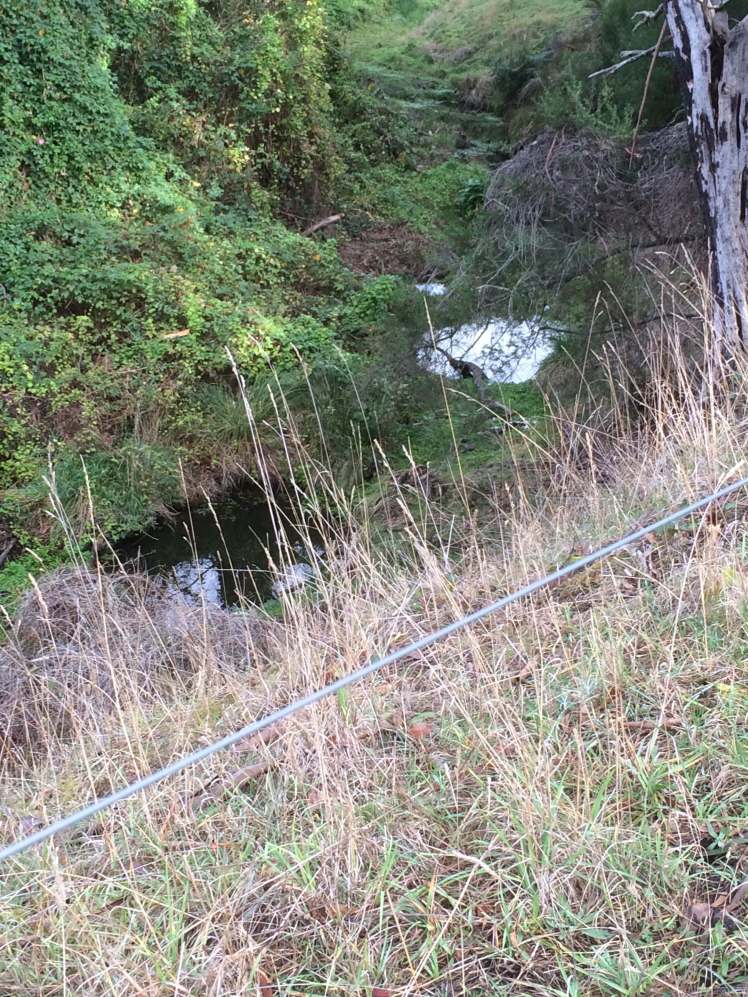
I  came to a stretch of eroding yellow cliff and there again was a rivulet stifled by a tangle of exotic weeds and creepers, forming a dirty pool from which a mere trickle emerged and entered the river.  It was only afterwards, when I was researching that I learned that this, for sure, was Cartwright Creek and that the pretty little cove just a short stroll south, sheltering in the elbow between this strip of shore and the sloping point, was the start of Cartwright Point.  I had thought Cartwright Point was at Taroona High School and so, when I did the walk, I could not place this rivulet or the cove.

A little path descended beside it and I walked a short way up it and looked about – and came face to face, yet again, with my blindness to landscape. There was a park up there.  And this modest rivulet had clearly enjoyed making itself a deep bed.  This was precisely where the road curved and Taroona began.

Cartwright Rivulet
Cartwright Rivulet

I have driven along Sandy Bay Road a zillion times, thinking about a zillion different things but never about the green space on the downward slope of that bend in the road.  The Truganini Reserve is on the other side – and in fact, it’s where Mount Nelson slopes down to the river at a fairly steep gradient because of the gully carved along its side by the rivulet.  Had you asked me, I could not have told you that this park is the Pierce Reserve or that it follows the banks of Cartwright Creek, a rivulet that has its source on Mount Nelson, enjoys sunlight and moonshine all the way, except for where it passes under the span of the road.  It would once have contributed delicacies from the mountain top to the river it was merging with. These days it’s shabby and sick.  If it was our pet, we’d be up for animal cruelty charges.  If it was our god,  bad luck would rain down on us…

I made a note to self:  find out more about this rivulet – and when I did, I was to discover that Mr George Cartwright, who along with his brother owned several farms on this shoreline and was ‘father of the Tasmanian bar’ was himself sometimes  out of order, in front of it for striking fear into the hearts of his neighbours.


Birds yacht from Crawfords
The view from the Cartwright Point area.  This yacht had kept pace with me for much of my walk.

Although I felt chastened by my ignorance,  I also had a sense of anticipation because I thought I knew what lay around the corner of the point, but I was in no rush to get there.  Cartwright Point is pretty and has the feeling of a private beach.  It was nice to linger.  I could not have been happier.

Cartwright Point
Looking back at the cove at Cartwright Point

I scrambled over boulders and requested right of way from a fallen eucalypt that lay across my path, and then I was on another beach, known but not known, grappling with another name, perhaps because Andrew Short and I viewed the beaches years apart and on different tides, perhaps because he numbers the beaches but doesn’t always mention them by name, perhaps because beaches can be tricksters… or maybe just because beaches are a human construct anyway.


Source:

Goc, N. 1997. Sandy Bay: a social history. Gentrx Publishing, Hobart.

Short, A.D. 2006.  Beaches of the Tasmanian coast and islands.  Sydney University Press, Sydney.


Derwent River: Blinking Billy to Hinsby Beach – Part 4

Sandy Bay’s wild side

A selection of photographs from Sandy Bay’s hidden shoreline.


Cement waterfall
Blinking Billy Beach 3. Disturbing structure


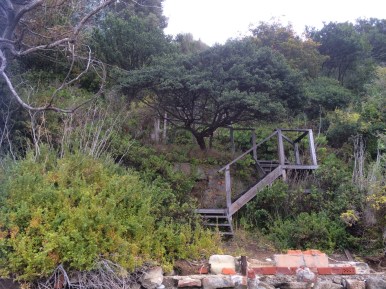
Once were steps
Steps to nowhere. Blinking Billy Beach 3 section


Another lonely boathouse
Another lonely boat shed
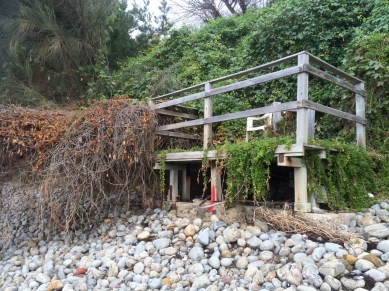
Detail with red brick
Detail, Blinking Billy Beach 3, southern end


Parties held long ago
Blinking Billy Beach 3


Blinking Billy 3 section old rails
On the Blinking Billy Beach 3 section


Boat on platform


Rockpool
Over the pebbles, over the sand, back to the reefs

Stepping down to the river

Private access, southern end of Blinking Billy Beach 3


Geology, Blinking Billy beach 3, southern point
Unconsolidated cliff.  Blinking Billy beach 3, southern point


Blinking Billy 3 from the south
Looking back at Blinking Billy beach 3 section


Gulls and yacht
Near Mitah Crescent;  yacht with the spinnaker


More steps
Before Mitah Crescent – structures on Blinking Billy Beach 3 southern end


View over my shoulder
Blinking Billy Beach 3


On the other side
Looking back at the beach shed and boulder at Mitah Crescent


Last Sandy Bay stretch pink deck
Mitah Crescent to Taroona section


South towards Taroona
After Mitah Crescent


IMG_3659.jpg

IMG_3647


Derwent River: Blinking Billy to Hinsby Beach – Part 3: To Mitah Crescent Cove

I Know You, Boulder

The walk continued…

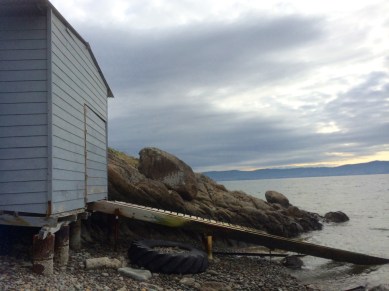
At the end of the beach I had to hop onto rocks and make my way between the river and a concrete wall.  Around  the corner  a wooden boatshed looked as though it might end my walk but I found a way around it and although my walk felt seamless this is where I regard the Blinking Billy Beach 3 section as beginning.   Just look at this picture.  Who’d think there was a city here?

Boatshed marking beginning of BB3
As you turn the corner at the point at the southern end of  Blinking Billy Beach 2 (aka Half Moon Bay) you see this structure.

The same subjects preoccupied me as I walked along – the geology, the history, the structures – and, specifically, locating myself on this piece of shoreline.  I kept changing my mind as to where I was in relation to the road above me but I wanted to do this walk without the help of Google Maps so that I had a real sense of (urban) adventuring into the unknown.

Blinking Billy 3 wild coast
As you turn the corner at the point at the southern end of  Blinking Billy Beach 2 (aka Half Moon Bay) you see this structure.

In  wild weather this would be a windswept stretch of rocky coastline with views north to town, south into Storm Bay and across the river to more loveliness along the southern section of the eastern shore.  On the day of my walk these lonely stretches felt pensive, secret and self-contained, and I felt myself more likely to encounter a nineteenth century smuggler along here than back at Red Chapel Beach or Blinking Billy Point.  At the same time I felt as though the shoreline was as aware of me as I was of it.

I figured I was out of Geography Bay and this new perspective of the river renewed my feeling of exhilaration in the landscape and perplexity about ourselves – that we Westerners have been here since the beginning of the 1800s and yet, so close to the city centre, the nomenclature is still so sparse as to be mostly non-existent and so slippery where it is there at all.   Many of us know more about London, Paris and places overseas than we do the intimate nooks and crannies of the river, the mountain and the great rifted catchment.

A few months after this walk I had a debate with a friend over just this issue.  He’s a man that does real adventuring and exploring – the further off the beaten tracks of this world and out of communication the better.  He is against nomenclature.  He wants the earth’s places (mountains, rivers) left untainted by names but is prepared to compromise on a latitude/longitude co-ordinate.

I feel differently.  As I walked along this stretch of coast wondering about the original aboriginal names for the places and features I was passing – names that over 30,000 years just have to have been rich, dense and redolent with mythology – it struck me like an epiphany, the extremely serious and overlooked disconnection we have with the earth.  A shrieking Disconnection.  A Disconnection so profound we’re trashing the planet beyond redemption and losing ourselves.  No names – no recognition. No relationship.  No honouring.  No sense of gratitude. I looked at the magnificent, powerful river that I love so much, as much a goddess as the Ganges, and wished ‘sacred’ had not become a disparaged word because if anything felt sacred it was the animation I perceived in this river and its shoreline, so dynamic and timeless despite our culture turned beautiful parasite glued to its side. At the most profound level this existential disconnection is manifesting in more damaged psyches as each generation becomes less connected to the earth because how do you honour yourself if you can’t relate to and stand in awe of the greater entity you’re part of?  As I wandered along the rocks, pausing to ponder their origins, diversity and beauty, I felt so utterly enthralled at the profligate beauty about me and a real grief that so many other compelling distractions have made it difficult for us to immerse ourselves in a landscape unfettered by human notions of time as was the case before our cultural evolution careered us away from hunting and gathering.

I had begun to pay more attention to my thoughts and less to the landscape when a sloping and strangely familiar boulder blocked my route.

Boulder and yacht
Hello, Boulder.

About two feet of estuary rose and fell about its base.  I didn’t want to take off my shoes and wade, the river’s temperature making it somewhat untouchable.  On the other hand, my first strategy for climbing up the boulder’s side was hampered by the fact that a few weeks before I had dislocated and fractured my little finger while working on the boat with our mechanic, who I think of as being to engines what Leonard Cohen is to music.

I put my hands on the sloping rock.  ‘I know you, Boulder.’  We had not met for a Very Long Time.  Looking up I noticed a huge house with enormous windows.  Now that was new to me.

When we were a whole lot younger we had come to  look at a  house – a beach shack really – at the bottom of Mitah Crescent.  The owners walked us through their cacti and succulent garden down to a large boulder.  The river lapped around its base but they assured us there was sand when the tide went out.   We desired that boulder and that river access but knew that once we had paid for the property we would not be able to afford renovations for a while to come and so we sadly and stupidly decided not to make an offer.

I  leaned my back against the boulder for a while, thinking that on this walk I’d barely noticed the Eastern Shore – I was so busy ‘paying attention’ (my current mantra) to the rocks about my feet and the all enveloping personality of the shore.  My iPhone was losing power rapidly because of happy snapping and  jubilant voice memos.  I looked back along the way I’d come.  I tested my finger’s capacity to help draw my weight up the side of the boulder.  Not looking good.

Looking back from Mitah Crescent
Looking back at Blinking Billy Beach 3 from Mitah Crescent

My options were limited – I could fall, climbing that boulder.  But if so, there was reason to hope that I’d be spotted sooner rather than later by the big windowed houses above me because at this point of the walk they had drawn closer and lower to the shore  and so I took my chances, shifted my weight from disabled finger to used-to-being-bruised knee.   Trying to be discrete, because I could not definitely recall whether the  boulder was a right of way, I crept across it, slithered down over the boat shed’s jetty and found myself in an intimate and beautiful sandy cove.  If the tide had been out when we’d viewed that house, we would both have lost our heads and hearts.

Cove at Mitah Crescent
Looking back at Mitah Crescent cove

More rocks, more pebbles, the occasional rivulet and astonishing discoveries.  I sometimes thought that paying too much attention to where I was about to place my feet I was missing out on rivulets, but in fact the way you find a Hobart rivulet is to use your nose.  As they emerge dishevelled and emaciated from their concrete prisons they bring with them a distinct smell: stale old detergent.  Yep.  The cleaner we are, the dirtier we make the environment.

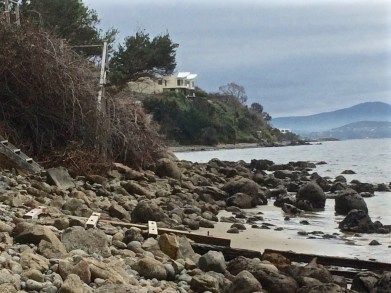
Then I encountered another boulder and, with an awkward gap, a double set of rails leading from boat sheds to the water.  I slithered down to the base of the boulder and timed my scramble for a gap in the waves – and made it under the structure.

Double boatshed
Double boat shed

I was about to leave Sandy Bay and enter the suburb of Taroona. but a little way around the next corner I found some more appealing structures and to my surprise, a sphinx like rock gazing out to sea.  It’s waypoints like this that would undoubtedly have carried names earlier in the Holocene and I paused, feeling the loss of the language that once sung this landscape into being, the loss of a way of being in the landscape and interpreting the subtle nuances our less sophisticated gaze  misses.  I work with people who have dementia.  In a more holistic way I think we have robbed the landscape of its earlier identity and a significant part of its memory.

Sphinx
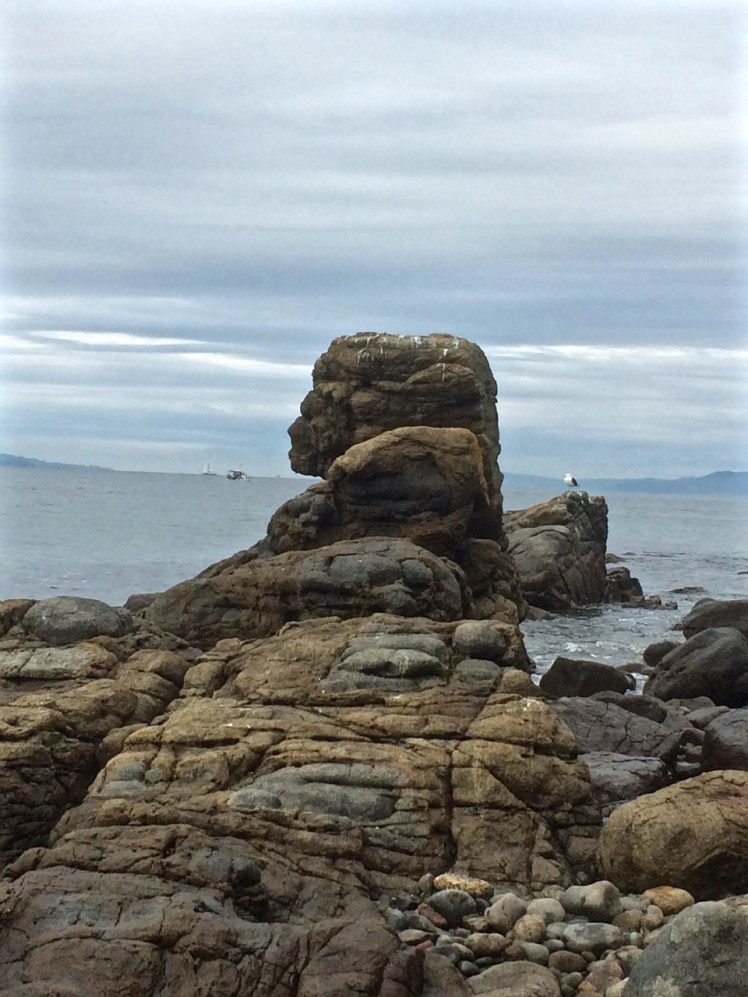
As you turn the corner at the point at the southern end of  Blinking Billy Beach 3 you see this structure.  In the absence of official nomenclature, my personal name for it is The Mouheenener Sentinal


And it was along this stretch of shore that I nagging awareness came to the fore – one huge river, but only a handful of avian wanderers.

Where the hell were the birds?

Next blog entry: Photographs – Blinking Billy to the Sandy Bay border


Blinking Billy to Hinsby Beach – Part 2: Geography Bay Beaches
 Into the Volcano

June, 2015

I woke with a huge sense of anticipation about this next walk, keen to get going, but  the aroma of coffee filled the kitchen, scrambled eggs were on offer and the woodheater warmed the house.  The flame robin in the garden seemed an auspicious omen and so I breakfasted at home in preference to stopping by a Long Beach cafe.

I saw yachts sailing  before a light northerly breeze as I approached my starting point. The sky was a milky dome of cloud and the landscape was quiet and dreamy.  It stayed that way all day and the  mountain was hidden from view except for occasional glimpses of forested flank through small gaps in the clouds.

There were plovers on the beach and a lone cormorant fishing as I set off down the path from Long Beach and soon I was swinging around Blinking Billy Point into Geography Bay, the old lighthouse on my right pressed up against the houses, past the old search light and the Charles Darwin Cliffs and down on to Blinking Billy Beach, the small waves breaking on the pebbles and little sand evident because the winter river had drowned the beach.
I had not always known this was the case.  I thought it’s disappearance indicated climate change, but the Salty Seadog had once told me it went submarine in winter.  On rough, wintry days the beach makes music, the cobbles rolling in the waves. The  Salty Seadog writes music and plays music so I guess it’s her kind of beach.


Blinking Billy Beach 1: the view from the north

I’d walked this coastline by the time I discovered Lena Lencek’s  book The Beach: The History of Paradise on Earth (2009) as an audio recording on Scribd, my new favourite app.  She’d spent her childhood in Trieste, enjoying the Adriatic coast and then her family moved to the USA and she got to know vastly different kinds of beaches.  Listening to this book at night, speakers in my ears, I learned about pocket beaches, and the landscape I was walking fell into place.

A pocket beach is normally a fairly thin, crescent shaped beach nestled between rocky headlands. It’s possible to find strings of them along coastlines – beach, headland, beach – and although they are sedimentary (the sand, shell and pebbles laid down in beautiful layers by water)  the headlands, and the rocky platforms at their feet, isolate the beaches from each other, and that means they can be subjected to different types of beach making and breaking processes, like the angle of waves and higher tides in winter which often cause them to disappear.  (And if, like me, you’d forgotten that tides are higher in winter, it’s because the sun, like the moon, has an influence on tides and in winter we’re tilted further away from the sun and so it’s gravitational pull is much slacker and the tides aren’t drawn back quite as much.)

I was so excited by this concept of pocket beaches that I just had to enlighten the geologist.  ‘I’m sure Blinking Billy is a pocket beach,’ I enthused.

He looked at me bemused. ‘We’re surrounded by pocket beaches,’ he said. ‘There are heaps of pocket beaches along the Derwent.  Name any one.  Chances are it’s a pocket beach.’  And thus began a second lesson in all things pocket beach and Derwent River.  I listened, but at the same time I was hatching a plan  to subvert the concept – each beach in my pocket.  I ordered vials off Etsi and began to gather each beach’s signature, it’s fingerprint in these tiny bottles.  Because this is the thing – the sand on each beach is different and after all, one day these beaches will really drown.

It’s a short walk from one end of the first Blinking Billy beach to the other but a little longer when the sand is submerged and you’re walking on cobbles.  At the far end I made a voice memo: ‘I’m about to go where I have never been before’.  That was because I’ve always been here with dogs, and I’ve always stopped obediently at the sign commanding no dogs to go any further because of seabird habitat.

Blinking Billy Beach 1: view from the south

I may never have been here but I knew that Darwin had.  He’d sailed into Hobart  on the Beagle in 1836 and been pretty unimpressed with the town initially but this changed as walked about.  He headed up the mountain, guided by the Sandy Bay Rivulet (my first recorded walk), he walked along the river’s eastern shore where I’m currently spending a bit of time  and he walked this coastline too.  I felt he was a suitable companion in spirit because he had the observant eye I lack and was able to make sense of the Derwent’s complex geology in a way I could not.  He’d named kunanyi/Mt Wellington Table Mountain, after another mountain I have lived beneath and his grandfather Erasmus and my sister both made Lichfield their home.  If he was up for a little idle chatter, conversation should flow. And there were moments on this walk when the landscape felt so timeless I felt I could well have encountered him contemplating pebbles and stones on some of the wilder sections.

Such was his observant eye that on his fifth day here he found volcanic rocks near Blinking Billy Point on his walk from Battery Point to Sandy Bay and realized that the cliff revealed two lava flows and that volcanic rocks lay strewn about. ‘Hah!’ was his reaction (or something like this).  ‘I’m standing in the eroded heart of an ancient volcano!’  He figured this out way back then yet many locals are unaware of this even today.

I’d stumbled into the heart of the volcano often and unknowingly, oblivious to the story the Charles Darwin cliffs were telling, more concerned about the smelly water that seems to be deposited straight onto the concrete path from a house above the cliffs and so the fact that Hobart is situated on the remnants of a volcano was news to me when, after this walk, I tried to make sense of it all.  The reef extending out to the John Garrow Light is an old lava flow and fault lines abound through this area.

I rounded the point at the end of the beach.  There, before my eyes, was another beach – Blinking Billy Beach 2, according to Short or Half Moon Bay, according to Leaman (1999).  In the distance, a man in a red jumper was throwing sticks for his dog.  I navigated a bit more reef and cobbles then stepped on to the sand.

The reef between Blinking Billy Beaches 1 & 2
The reef between Blinking Billy Beaches 1 & 2 (aka Half Moon Bay)

A cockatoo flew overhead, yelling for its mob.  And then again more pebbles and then another sandy stretch and another six private stairways down onto the beach.   I noticed a rivulet.  This is poor little Folder Rivulet, according to Andrew Short, emerging out of its drain into sunlight, unloved and disregarded, too tiny to matter.  (I watched this little rivulet being bulldozed unceremoniously into its drain, back in the day.  It looked so wrong it hurt.  And recently I returned to its valley to try to discover how much of it can still be seen above ground.  Not much.)  We communed, the rivulet and I, and then I took photos of beautiful conglomerate rocks and and made another voice memo:

I’m on another sandy cove with some interesting old beach structures. It’s quite a long sandy cove with a rocky reef in the centre of it.  As I walked along the second stretch of sand a white speed boat came up river and the yacht I’d thought was leading the race (they rounded the buoy at Nutgrove all bunched up) has proceeded on down the river with its spinnaker up… this is such a lovely walk.’

Blinking Billy Beach 2 from the north

And it was true; I felt elated, thrown back into childhood recollections of The Famous Five and their explorations which we tried to mimic on holidays on South Africa’s eastern seaboard.  I felt invigorated by a sense of adventure and discovery and on this beach there were so many new discoveries – new perspectives of the river and tiny, exquisite details.


Tiny blue periwinkles BB2

Here’s the southern end of the beach, and the man and the dog had already disappeared around the corner.

Southern end of Blinking Billy beach 2


Blinking Billy Beach 2 from the south

The reef at this end of the beach held my attention for quite some time.  The rocks were interesting, human debris, although depressing, also managed to look artistic and  I began to do a little bit of amateur geological sleuthing perplexed by rocks that didn’t always seem to belong together – sedimentary, conglomerate and igneous, worn red bricks, smashed and violently weathered rock, unconsolidated slopes, conglomerates of modern material – and delicate combinations of life forms were represented here or lay ahead of me.


Found on Blinking Billy Beach 2
Beach detail.
Beach detail.


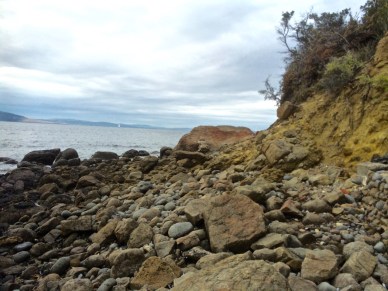
When I reached the next point there was a yellow unconsolidated cliff, a wall someone had built beneath it, and a rosy coloured boulder near an intrusion.

I was seriously losing track of where I was in relation to Blinking Billy beach numbers as devised by Andrew Short (see The Book Shelf) and I hadn’t got very far at all.  I was lost in thoughts to do with defining beaches –  how much sand do you need before you have a cove?  How much before you have a beach?  Were the long stretches of boulders and pebbles actually beaches at all or just the bits in between?

And did it even matter where beaches began and ended scientifically, subjectively or according to the whimsy of the tides when I was engrossed in the landscape, entranced by the huge views and fabulous details – utterly blown away by the wild grandeur so totally divorced, below the cliffs from the houses  in some other more banal, irrelevant world up top?

This coastline is divine but also tragic because it’s along here that the mouheenener once walked with confidence, and after their lands had been taken that traumatised families would have retreated.

To be continued…

Sources:

Leaman, David. 1999. Walk into history in Southern Tasmania. Lehman Geophysics, Hobart

Royal Society of Tasmania, Charles Darwin in Hobart Town, edited by Margaret Davies, Hobart, Royal Society of Tasmania, 2009.