Derwent River: A Beautiful Geology

But Where Does the Beach Start, and Where Does it End?

beach near trywork

At first I thought I’d simply visit each sandy beach, but within the first few minutes of our initial walk at South Arm I’d scrapped that plan.  Beaches are not disconnected from their rocky platforms or the coastline that surrounds them; it’s not possible to see the whole magnificent geology by looking at grains of sand even though they say a lot.

I was also immediately confronted by the question about what makes a beach.  Bedrock geology occupies about 60% of the shoreline so there’s a lot of hard rock.  The remaining 40% of the coast comprise sandy beaches; some tiny, waveless coves, some long surf beaches, each with their own sandy signature.

On walks with the geologist, we got to talking about how beaches are made.  We’re a tiny island hammered by the Roaring Forties.  Weather passes through and clearly subscribes to the view that when visiting, more than three days and you stink like a fish.  The cold fronts run hasty circles around the Southern Ocean.  I’m glad to see one go, I’m enjoying the mellowness that confirms my belief that there’s no better place on earth to live than on this island, when goddamit, that warm weather is shoved out by another cold front arriving in a temper and I have to down traveller and reef, close windows and crank up the woodstove, add another layer of thermals before heading down to the marina.  But our beaches face every which way, so for each one exposed to the prevailing wind another provides a safe anchorage or a sheltered nook be you human, seal or seabird.

A ripple becomes a wave, the moon entices then releases the ocean making a yo-yo of the tides, currents wend their way through the oceans deep and deep below the layer we’re a part of, magma schmoozes through fissures and cracks melting all opposition, adding its power to the building and destruction of coastlines.   With humankind intent on weighing in, turning tropical our polar waters and usurping the earth building roles of rivulets and the like, we’re bringing the Holocene that nurtured us to a climactic close.

I went looking for a definition of a beach.  I found long, technical ones that sounded far too complex for me so I decided a beach was where there was enough sand that the word ‘beach’ popped into my head.  Still, I would have to become attuned to where a beach began or ended and was going to learn that it was no easy matter.

That’s why I’m glad I started with the Derwent River beaches.  I’d no sooner get home than uncertainty about what I’d noticed – or, more usually, failed to notice – would assail me and back I’d go.  I’d go back often just for the pleasure of revisiting or to take a friend to see what I had found.  I’d go back because I’d begun to doubt my point of view, wanted to confirm the beach’s perspective both literally and figuratively, and because, the way I see it, neither the beach nor I are different and neither are we the same each time we meet.

Percentages sourced from Short, A.D. 2006.  Beaches of the Tasmanian coast and islands.  Sydney University Press, Sydney.

Tasmanian Beaches: Reflection 2: On Rivulets and Reciprocity

The Long Bond

SBR

Since completing my walk along the rivulet I’ve struck up a different kind of relationship with it. At night, I might see the moon or hear the owl – or, like last night – go out to see the aurora – but I‘m also conscious of the rivulet flowing down it’s almost totally urban catchment and I can visualise its whole sinuous extent.

In spare moments I’ve been seeking it out again – in Greenlands Avenue, down the Jackson’s Bend Path and on into Turnip Fields. Once I noticed a soft, earthy hole on the high side of the O’Grady’s Track into which (when its running) it disappears to travel under the path.

One very still day on that track, I stopped and looked up. The summit road wasn’t far away. Even with my poor spatial skills I could not get lost. And so I left the path and bushbashed up, through deep leafy deposits and over rotten, mossy tree trunks, perfect places for leaches to lay their eggs, dragging myself up onto the road as car tyres whooshed past quite close to my nose.

And I can say with authority that when you emerge on the summit road it is right there on the other side keeping company momentarily with the Radford Track. A cloth nappy lay in the stormwater drain that carries it beneath the road, a disposable coffee mug some distance off but otherwise, for a moment, the road was quiet and the forest fragrant.

I reflected that in the short time I’ve properly known it, the rivulet has taught me, profoundly, that small, local adventures ground you in place.  The day was a still one but just briefly, the breeze came sweeping through the canopy and elevated the moment into a happy sense of contentment.
My tiny quests had solved a mystery. One report I read said that the rivulet rose no higher than Huon Road. Another said it begins above O’Gradys at The Springs. I dispute both. Where there is a summit there is a source. You could say that it begins as that raindrop hanging from the tip of that rock on the peak. I will contend it rises in the steam from my coffee, the warmth of your breath.

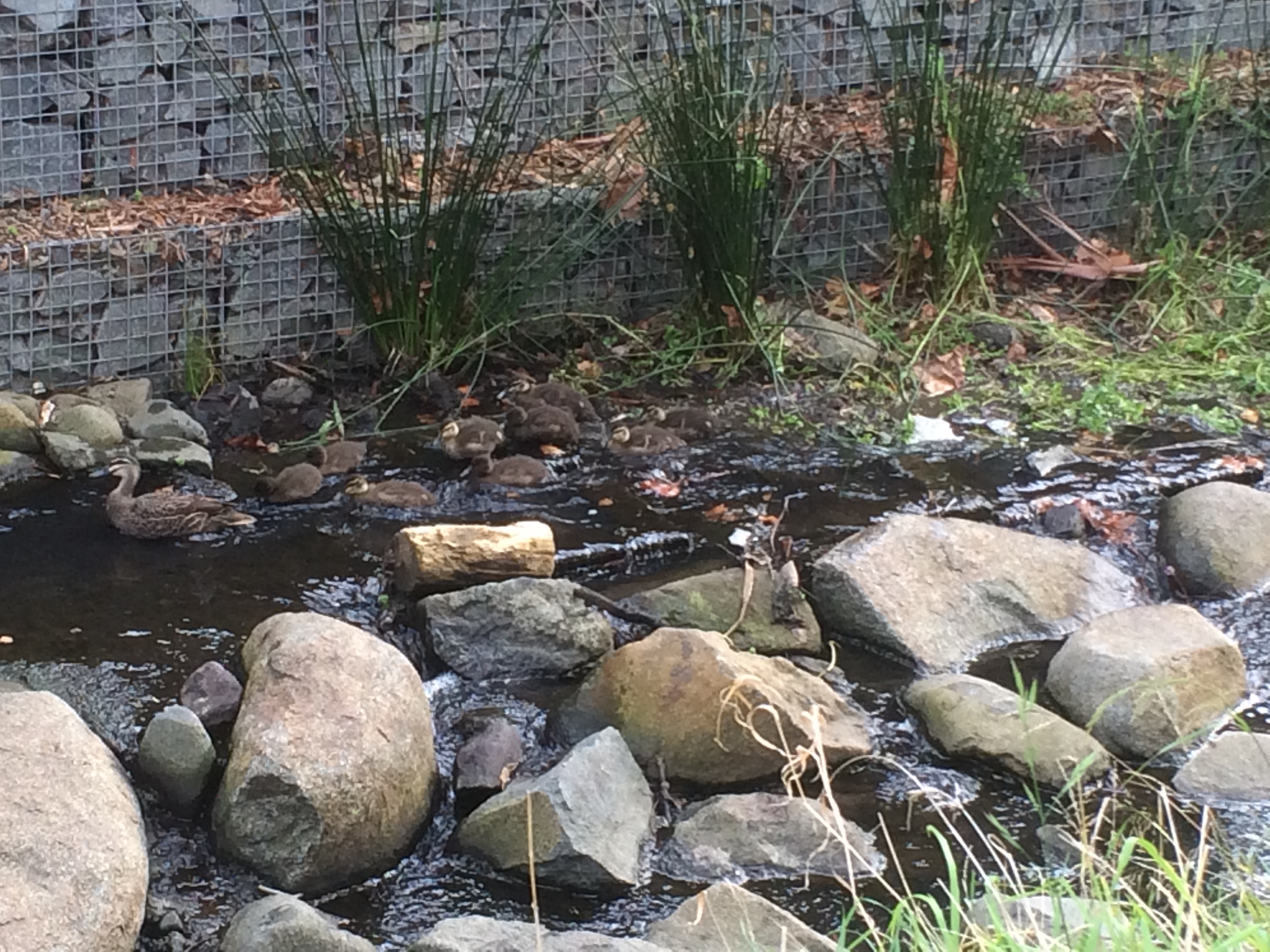
I felt I owed reciprocation for the gifts I felt it had bestowed on me – perhaps go and hitch those underpants off that rock or gather up the garbage to make life that bit easier for those most tolerant of native fauna who still, astonishingly, manage to inhabit some of the rivulet, for the duck and her ducklings and for the grey heron I saw one day on its banks.

But then I found The Friends of the Sandy Bay Rivulet and took myself off to meet them. I grabbed a rubbish bag and while some people planted I yanked out sticky weed and picked up litter. Afterwards, over a cup of coffee I discovered one person had a deep knowledge of local history including beaches. Two others were yachties and so we sat in bands of sunshine and drizzle and talked about history, the rivulet, beaches and sailing and I would not have missed that morning for the world.

I’m not done with the Rivulet yet but that’s secret business between the rivulet and me.  The next posting really will be on beaches.

Postscript

About two weeks after writing this Susan Murphy came to Hobart to talk about her new book, Minding the Earth, Mending the World.  What she had to say about our disconnection from the earth really resonated with me.  I went up afterwards to have a chat.  In my copy of her book she wrote ‘luckily we can’t walk the same rivulet twice.’

Back at home I opened her book and began to read, and this is what I read on pg 1.

Perhaps the origin of any book, like the source of a river, is finally impossible to separate from all that is and will be.  For which of a dozen or more feeder springs do you choose; or earlier that that, which moss bank dripping over a rock ledge, which raindrop that fell in a catchment; and how to put a date to a raindrop which is really as old as the earth, and in fact even older, as old as the elements formed in the earliest supernovae explosions?  Or back to the start of time itself, arriving together with matter and energy some trillionth of a second after whatever unimaginable occurrence marked the birth of the ongoing revelation that we call the universe?’

Cleaning up with the Friends of the SBR

After we’d finished our work today a duck and her ducklings manoeuvred up the rivulet.  This is the habitat we’ve left for other species to struggle with. (Rushes courtesy of the Friends of the SBR.  If you live in the catchment (and even if you don’t) please consider helping out.)

~~~~~~~~~~

Literature

The literature is full of detail I’d have loved to add to these posts.  See The Book Shelf for further information.

Walking the Sandy Bay Rivulet From Source to Estuary Part 4

Roughed up in the ‘burbs.

Track to Romilly Road

South Hobart, Dynnyrne, Sandy Bay – the suburban route began with a nondescript path outside the park gates that ran downhill to the rivulet, returning in a rush to its natural bed. I explored a bit, then crossed it to reach the forest track above it through to Romilly Road.

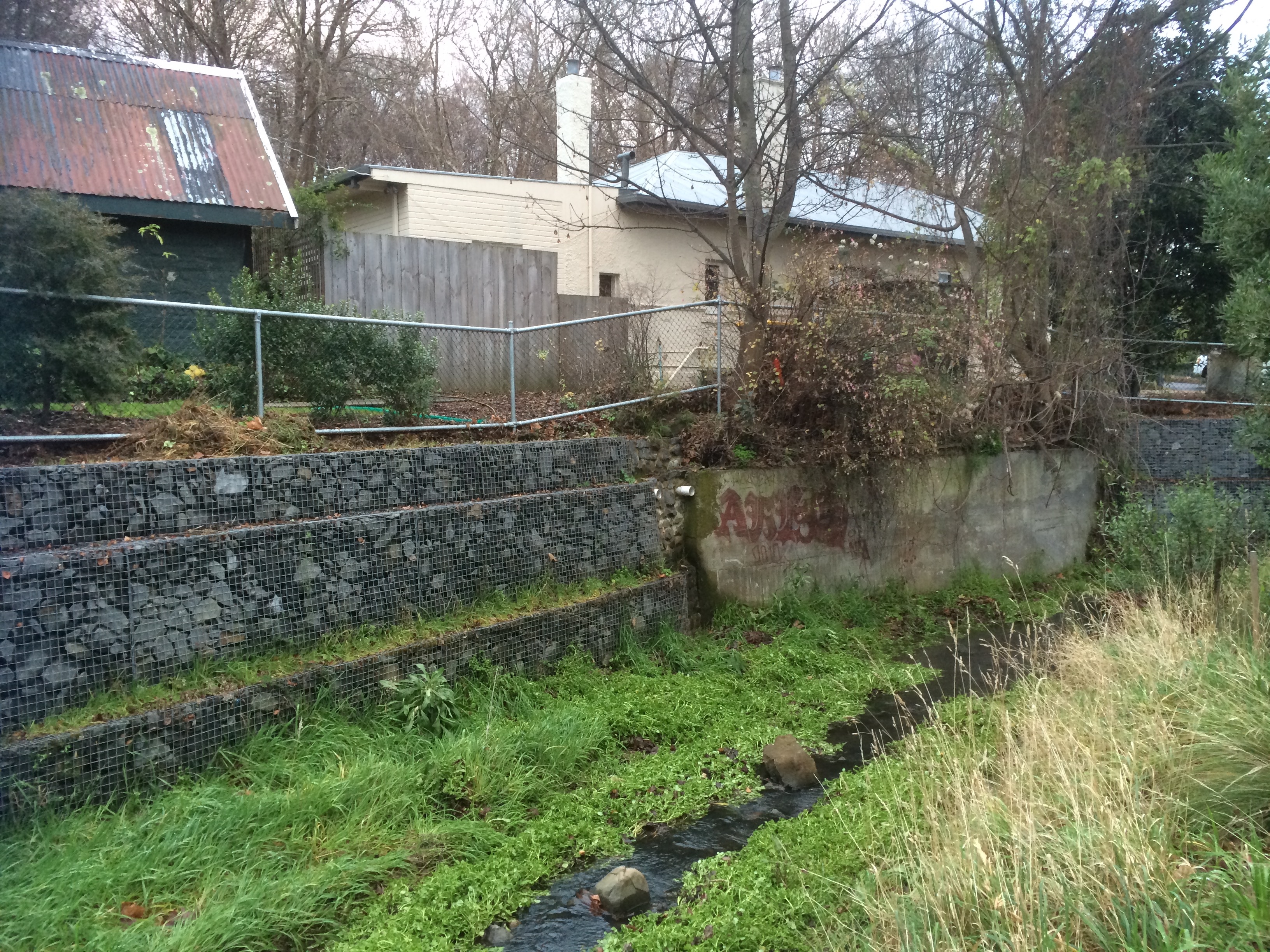
So here’s the sobering truth.  The houses begin and the rivulet gets roughed up.  A sign of worse to come, it travels between banks entangled with blackberries and forgot me nots, lawns and paddock.  Some gardens make it their focus, others shun it.  Regardless, it sounded almost cheerful flowing thin and narrow at this interface between forest and habitation. I had a good view of the state of affairs; this path follows a higher contour just below Stony Steps, another of Hobart’s secret places.   There were cliffs; I reflected on how this rivulet, eons ago, before its landscaping capacity had been thwarted by us newbies, had carved an impressively deep valley.

I arrived at Romilly Street.  After my wanderings the concrete seemed cold, shadowed and unforgiving.  I, myself, mentally immersed in the rivulet, felt out of place as I paused to take some photos from the bridge.  I could see no way of getting to the bottom.  It was the domain of the ducks.

You barely catch a glimpse of the rivulet on the last stretch of Waterworks Road and what you see is hardly edifying. By the time it gets to Linton Avenue it looks scruffy and unkempt – and then it’s gone!  it simply disappears beneath the road.

With a sense of anticipation, I  took the little path I’d discovered at Linton Avenue on a previous sortie, full of anticipation that I would burst through into the park but my conjecture was wrong.  It led me through to an enclave of flats. Back on Linton, I peered through a wild tangle of tall, dense brambles and weeds, a sign of neglect that indicated a rivulet could well be travelling underneath.   There was nothing to see, nowhere to go and so at the Foodstore on King I turned into Overall Street, braving a soapy smelling periwinkle clad bank, down to the rivulet, where I stood over it taking photos of where it emerges from its tunnel and its route down through the park.  Then I chose to walk the road rather than that sodden weed infested bank and encountered it at Parliament Street where it travels beside the oval. I was retracing my steps from a brief exploration of this area the previous week.

That morning frost had crunched under my shoes as I walked upstream along the rivulet flowing  between gardens and park.  I’d tiptoed past a tiny tent in a hidden glade (someone sleeping rough)  and had expected to emerge on Linton Avenue but had arrived, instead, on the freeway, quickly ducking back down lest I be noticed by the morning traffic.

Again I crossed the road.  There was the place where I’d stopped to chat with a man who directed my attention to a house, once a mill, on the banks of the rivulet, and there again, down a steep descent, was the end of  Fitzroy Place and the woebegone rivulet now in a stormwater drain heading beneath Regent Street.  I sauntered down Queen Street and detoured into Lincoln Street to meet it again where the story was one of ducks and daks – ducks fossicking on the bank and old underpants caught on a rock.

I walked down Jersey Street and found the rivulet carrying a plastic bag.  I was there to greet it at Dr Syntax, where it had accumulated plastic cartons and I was there as it entered another stormwater drain (yep, we really esteem this rivulet) and was there to witness it running down its gutter behind the back gardens on Osborne Road.  Sombered, I headed down Quayle Street.

Down near the beach the rivulet gets some recognition but litter marrs the scene – spray cans, McDonalds takeaway products, trapped by a buffer – Mary Ann Bay Beach is grateful. What a terribly filthy, crass minded species we are, I was thinking, and then a welcoming tide came rolling in, and the rivulet, once fragrant, now toxic, depleted itself into the Derwent.  My dogs rushed to greet me and the geologist waited.  Short Beach was lit with slow afternoon activity and the light was mellow.  Feeling like a traveller arriving in another land, I was both buoyed by the loveliness of the walk to Romilly, the activity on the Esplanade and sobered by how quickly the rivulet had been ravaged.

We found a bench, we spread a cloth, we poured puerh tea, and sitting side by side eating chocolate and imbibing this smooth antique tea, I told the geologist of the places I’d been and the things that I’d seen.

SBR at top of Wwks Rd
Meeting forget-me-nots, top of Waterworks Rd

Waterworks

Sandy Bay Rivulet running past Pillinger Road
Sandy Bay Rivulet from Dr Syntax
Sandy Bay Rivulet mouth, Short Beach Sandy Bay
Tea time after the rivulet walk

Walking the Sandy Bay Rivulet from Source to Estuary Part 3

Part 3:  Hall’s Saddle to Waterworks: A rivulet’s point of view

Ridgeway 1 The third stage begins:  Hall’s Saddle

I was strolling a high contour,  the tiny cluster of houses at Finger Post on the far side of the valley.  Far below, the rivulet flowed beneath the forest canopy in the Turnip Fields valley and as I walked I tried to hold its presence in my mind.    Turnip Fields Turnip Fields

The houses on Huon Road hove into sight and the  Derwent River in the distance.  Gracious eucalypts beside the path had bark I had to stop and admire, she-oaks, orange banksia in blossom, and closer to my feet the tiny red flare of epacris impressa.  I was relishing my solitude, enjoying the rhythm of my stride but making slow progress – there were a lot of little water courses I kept stopping to examine.  Alone with my thoughts I faced the same question with the rivulet that I’d had when walking above Mitchells Beach on the South Arm Peninsula:  how close must you physically be to something to be actually walking  it?  And in what way can you be said to be walking something when you don’t know it’s there?  (I was thinking particularly of rivulets in the city and how, walking down a road we are most of us unaware that a rivulet might be flowing beneath us, imprisoned in a drain.)

Ridgeway 3 Near McDermotts Saddle

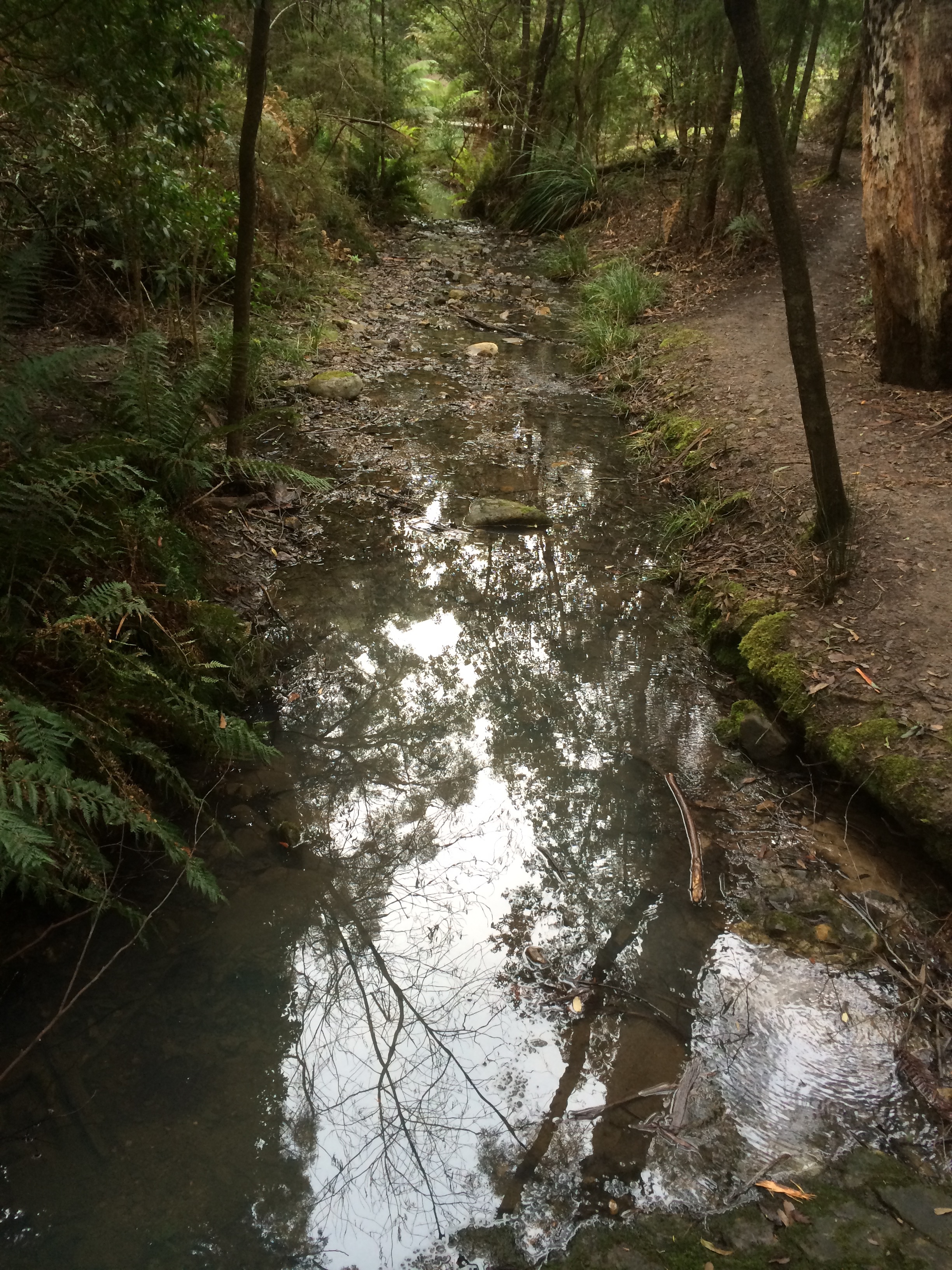
I reached the abandoned paddocks of McDermotts Saddle, the lumpy land that bears old traces of a building.  Superb blue wrens flitted ahead of me and a raven called lazily.  A little while later I got a view of dark water down at Waterworks. I came to the steps and descended, then lingered.  Gentle Annie Falls and a series of cliffs demanded exploration – their’s is a long quiet dreaming up here in the eucalypt forest.   Contemplation over, I followed the Circuit track, paused again at a poignant memorial seat to young life cut short, then finally arrived down at the rivulet at last, just where it emerged from the forest running small and shallow, slightly cloudy, over its dark forest bed, a stride wide, meandering around boulders.  I walked beside it companionably, stopping to capture its voice at a cliff and again where it runs over pebbles.

Rivulet The rivulet enters Waterworks

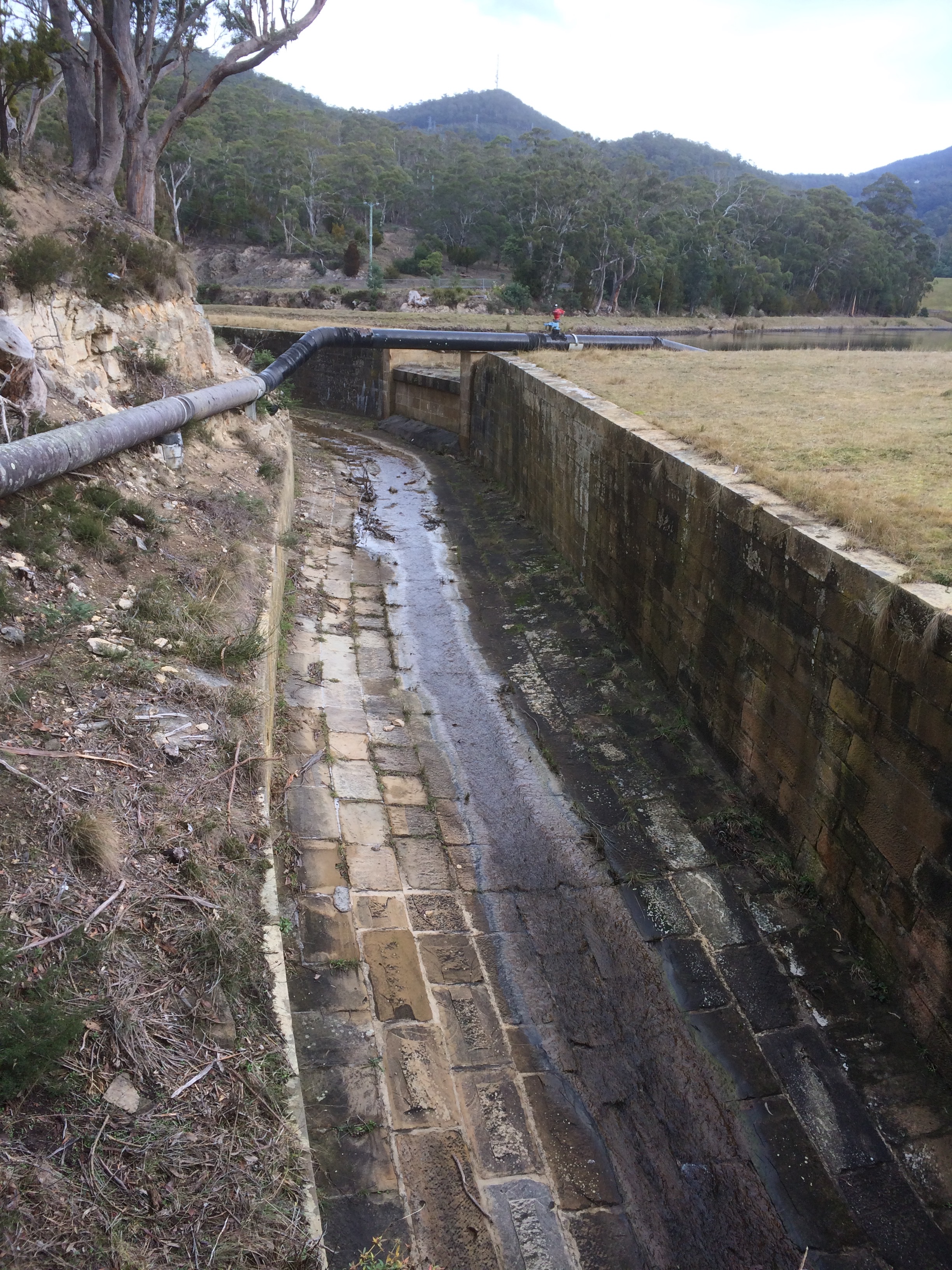
Shortly after this I had a choice of path but the rivulet had none. The rivulet is tricked as soon as it enters Waterworks,  apparently for the misdemeanour of flooding (or landscape building, depending on your perspective) in earlier days.   It is  sneakily led into a moat that runs around the reservoir to the right while the usurper, the reservoir, inhabits the bed the rivulet made like a gigantic cuckoo’s egg.

Reservoir Cuckoo’s egg: The Reservoir

I could have walked beside it, commiserating, but having been that way so many times before (the bitumen, the picnic tables), I went left and walked a forest trail.  As usual the gulls were hanging out on the water and when I crossed over between the upper and lower reservoirs  there was a raven grubbing for food, some tassie hens, ducks and plovers. Munching on an apple, I rejoined the disheartened rivulet as it moved unwillingly down its moat, squeezing itself into the very centre as though it didn’t really belong there.  I passed a bbq in action and a couple arm in arm enjoying the view.   Two ducks, flying low, winged pass me on their way up to the top reservoir and as I approached the gate I spotted the first exotic plants: an escaped agapanthus.  It was a harbinger of things to come.

MoatDisplaced rivulet: the ecosystem blanks out. No life to foster, no landscape to build

Walking the Sandy Bay Rivulet From Source to Estuary Part 1

Part One:  Being Random

Because I live in the Sandy Bay Rivulet’s catchment, it seemed symbolic that I should kick off my beach walks by strolling the Sandy Bay Rivulet from its source at The Springs (about half way up the mountain) to Short Beach where it enters the Derwent.  I looked at the spurs high up near the summit, figuring out the catchment zone.  I read reports and discovered some conflicting facts about where its source is believed to be.  I did some sleuthing, discovering it here and there as it meandered through its urban reaches.  I made an astounding discovery – or so I thought.  It’s the rivulet that flows beside my favourite forest track.

‘You’re going to walk the what?’ said my friends.  It seems that even if you live in its catchment, on the landscape it has made, the rivulet is out of sight and out of mind.

While vacuuming one day, it occurred to me that it must flow through Turnip Fields.  I cut that chore short and went to explore this little known spot.  From the road I saw new houses with names like Mystic Way, and the Derwent, like a heart-shaped lake, captured by the foothills.  I saw the reservoir at Waterworks and down on the valley floor, blocked by private property, I saw the forest it must surely run through.

The one thing I didn’t do was consult a map.

Confident I now knew its route, I told the geologist I would follow the rivulet that slips down beside ‘the leech path’ to Jackson’s Bend on Huon Road.  There’s a steep, forested valley on the lower side and I imagined I would slither down into this copse with my sailing boots in my rucksack in case I had to slosh my way down the rivulet itself.  Over drinks the geologist explained that I would need a compass, that the bush would be dense, and quite possibly impenetrable over the rivulet.  He told me it was even conceivable I could fall over a cliff and die.

I was disbelieving.  The copse is narrow but it’s true the slope is steep.  I had thought of my descent into the valley as a drop into an unknown world – old memories of the Famous Five had stirred, awakening my inner George.  ‘Forget it,’ said the geologist, and told me of his efforts to push through horizontal and the achingly slow progress he had made.  ‘Only masochists will go into that stuff.  There’s too little reward.’

I was unconvinced but I didn’t like the idea of encountering old bones (that cliff!) or trespassing and encountering a landowner bristling with weapons, as occurred to some others in a 4×4 recently.  And so I agreed to begin at The Springs and to follow a more conventional way down to the river.

From the Springs to the River: Radfords Track

Kunanyi

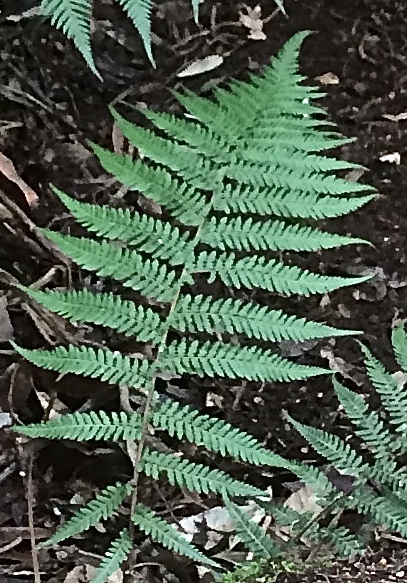
fern

One Christmas when I was new to Hobart, my friend and I rode up the mountain, a long slow ride that kept me at eye level with some of its passing features and wobbling as I got distracted by the silencing view beneath us.  The plants, the water dripping through the sliced soil at the road’s edge, the tall forests of eucalypts and rainforest species, the fragrant air and then in the alpine zone the sculpturally stunted snow gums and cushion plants, were hard and breathless work to get to know.

A rest at the summit, the chill, the distant view of the South West, the disorientating landscape of peninsulas and islands, most of south eastern Tasmania spread out about us, and then the exhilaration of sweeping back down its long flank on the narrow road, all the way back to the city.

The first beaches I’m exploring lie beneath the mountain, the usual term Hobartians use to name it up but when one day not so long ago I turned on to the summit road and saw the new kunanyi / Mt Wellington sign, I thought, quite simply, ‘YES!’

I’d almost forgotten Uluru was once Ayer’s Rock and frankly, for a massive mountain to be bequeathed the name of a mere mortal in a distant land, is an archaic notion. The mountain, through the Ice Ages and the Holocene and past the date of European settlement, carried many names (Unghanyahletta, Pooranetere and others), because there were different languages and dialects spoken here but in 2013, at a ceremony on its summit, the government announced its new dual naming nomenclature policy, a late acknowledgement that this land once had other more authentic and richer names than it currently carries.

Kunanyi

The mountain rises above the city like Table Mountain over Cape Town and although the foothills disguise this fact, kunanyi is actually the taller of the two. In February 1804, dissatisfied with the initial settlement at Risdon Cove, a small party landed at Sullivan’s Cove on the western shore.  In a letter that month the Governor said  there ‘there is a run of clear fresh water, proceeding from a distance and having its source in a rock in the vicinity of Table Mountain…’ (HRA 3,1 p 223 Collins to King 29 February 1804).  Clearly a similarity between the two mountains, the way cloud snags on their summits, had been noted.

We think 100 years a lengthy span.  Kunanyi took the Permian, Triassic and Jurassic ages to achieve its character.  Geologists look at it and see a horst.  For a sailor or explorer, like George Bass, who noted it in 1798, it’s a most significant landmark.  The early settlers appreciated its water but took to soiling it immediately, used as they were to the sewers and drains of cities like London.  Kunanyi had been seen as sacred, the relationship non-duelist, totemic, but Europeans put a higher value on utility and took its timber, stone, wildlife, plants and water.  Non-duelist myself, I can’t begin to imagine the pain that those clans, pushed out of their own home, felt as they watched the earth they belonged to desecrated so wantonly.  Had the new arrivals not been so Cartesian in their perspectives, words like threatened, endangered and extinct would, just maybe, not apply to Tasmania’s natural wealth like it does today.

Mountain fires, floods, landslides, eras, climates and species come and go and despite the  recreational, weather and telecommunication structures on its summit, it’s still magnificent, sometimes so solidly present, sometimes ethereal, and occasionally in humid weather, like a dreamtime serpent, a long ribbon of cloud  slithers through the valleys and wraps itself around the mountain, creating an atmosphere of mystery.

It has a secret night life, most denizens being nocturnal – the chorussing frogs, the sugar gliders, the wallabies, the boobook owl – and it has a diversity of plants, is criss crossed with paths and rivulets, studded with huts and waterfalls. In 1906 the mountain got a little more breathing space from people when it became a park.  When you go walking, its best to be prepared because like so many mountains, it’s wild and can be tempestuous and even today has the capacity to snatch up lives.

This has been a cold winter and most unusually there has been snow on the summit almost every day.  I’m looking at those snow flecked cliffs, the Organ Pipes, up at the peak.  I know that around the corner The Lost World is also under snow.  I’ve been sailing the river and walking the beaches, and making my plans to follow that rivulet whose catchment I live in, (with its tendrils starting above our home, behind it, in front of it and below it)  from its accepted source at The Springs down to the beach at Sandy Bay.

And in walking the rivulet, I’ll also be walking kunanyi.

kunanyi sunset
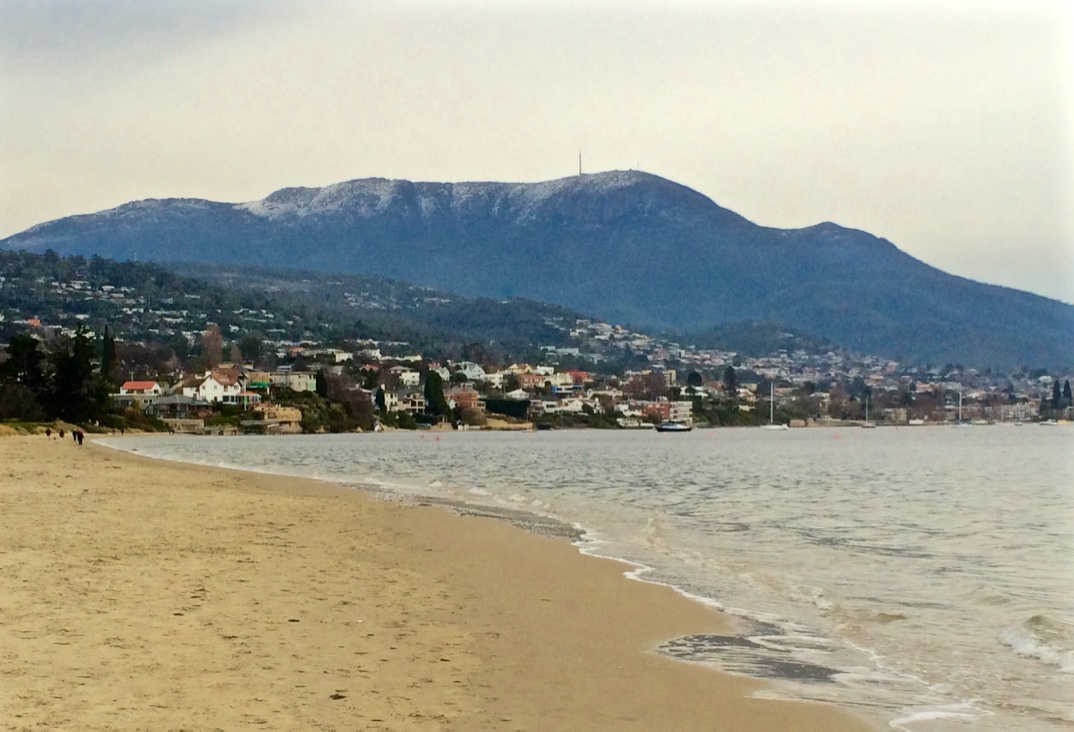
kunanyi viewed from the Eastern Shore

Inspiration Has Many Threads (4)

Written on a finger nail

Version 4

Simplicity, simplicity, simplicity!  I say, let your affairs be as two or three, and not a hundred or a thousand; instead of a million count half a dozen, and keep your accounts on your thumb-nail.  In the midst of this chopping sea of civilized life, such are the clouds and storms and quicksands and thousand-and-one items to be allowed for, that a man has to live, if he would not founder and go to the bottom and not make his port at all, by dead reckoning, ~ Henry David Thoreau

Easy to say, difficult to do.  This plan will be competing with other projects I have on the go, which is why my preference is for one I can stretch, shrink or reshape depending on circumstances. Keeping it simple makes sense.  A few clear waypoints might support my dead reckoning capabilities. Tasmania is both hefty and plump as islands go but the shorelines can be toothy.  The coastline is broken by estuaries, large bays and  drowned river valleys.  Is it feasible to walk beaches, and rock hop around the island?  I doubt it.  It would not take long before a cliff would call a halt, or private land deny the way.  And what makes a beach anyway?  How big must a patch of sand be before it can be adorned with the title of cove or  beach?  How do you manoeuvre between beaches when topography, vegetation or private ownership block you?  Is this project about Sand or Shore?  Beaches or coastlines? I decided I would start by exploring in little stages, not necessarily orderly.  I’d allow for impulse and serendipity,   backtracking and leaps forward, short strides out and longer meanders, walks, paddles, bike rides or sails  of an hour or two or weekends and longer away.  I’m wondering if  my motivation will fade as barriers present themselves and how I’ll manage flagging energy or competing interests.

I met a friend for lunch.  She brought enthusiasm and beach pamphlets, and we discussed joint ‘expeditions.’  Then, as I had breakfast one April morning with the geologist, he suggested we start at Opossum Bay.

‘Let’s do it today,’ I said.  And just like that we did.

South Arm and Betsy Island
South Arm and Betsy Island viewed from Lower Sandy Bay, Derwent River.

Inspiration Has Many Threads (3)

Small Adventures

Version 3

We live in a wonderful world that is full of beauty, charm and adventure. There is no end to the adventures that we can have if only we seek them with our eyes open. 

~ Jawaharial Nehru

This year no further overseas travel is on the agenda. A small yacht, perfect for exploring the Derwent and the D’Entrecasteaux, has been nibbling at my wallet as yachts and ponies are known to do.  But the boat is a partnered venture. There are weekends when I’m free to do other things.

One Sunday, with the boat on the hard, I suggested we go up the Derwent Valley, away from the coast, to see the leaves turning. At Plenty we kept on going. Soon we were passing the farm where we’d once holidayed with friends. A fine drizzle blurred the land but on we went into territory I’d all but forgotten. I could barely remember the Craigbourne Dam and it was a novelty to stop in Hamilton (a tiny sandstone town surrounded by hills) for a coffee.

This sense of disconnection had me thinking about local adventures – small adventures with more modest carbon footprints than jet planes. Deciding against googling the definition of ‘small adventures’ I decided that for my purposes a small adventure would be limited to the state, either planned or serendipitous. I believe you can have an adventure sitting mindfully in a garden if you are open to the world about you. It’s how birds land on your head and skinks climb over you. There does not need to be high drama or fear of loss of life or limb. An event or occasion can be an adventure, it simply depends on cultivating a particular state of mind, squeezing adventure from what’s already known and ordinary. An adventure can be minuscule but the pleasure can be immense. It could involve an epiphany. Conversely, there could be terror.

I had thought, when I took up sailing, that I would drift beneath a blue sky sipping gin and tonics. Instead I’ve got to know the wild wind and I’ve enjoyed countless exhilarating days on local waterways, getting to know these aspects of the island better but neglecting to stay in touch with others.
So I made a decision. My year of small adventures would be opportunistic and would focus largely on sailing and beaches, be that by foot, kayak or bicycle.  And for that I needed a plan.

Kelp detail


Inspiration Has Many Threads (2)

It’s Written in the Literature

Version 3

I began these pages for myself, in order to think out my own particular pattern of living, my own individual balance of life, work and human relationships…  My situation had, in certain ways, more freedom than that of most people, and in certain other ways, much less.

― Anne Morrow Lindbergh, Gift from the Sea

When I was pondering the shape this blog should take, it wasn’t to other blogs that I turned but to my friends, the books.  My reading for pleasure over the past year has been almost solely confined to sailing – mostly circumnavigations by people made of different stuff:  Bernard Moitessier, Joshua Slocum and Tania Aebi to name a few.  I thought about the writer’s like Dervla Murphy, who have carried me with them on their bicycles, writers like Laurie Lee with whom I walked out one midsummer morning through England and into Franco’s Spain, while  managing to co-exist in a boiling high school classroom.

Recently I’ve been listening late at night to The Old Ways: A Journey on Foot by Robert MacFarlane. One moment we’re on an ancient pathway then I wake up to find I’m with him on a boat.  Roger Deakin (‘I went to Wales because the place was stiff with magic’) would be right at home adding the chilly Derwent to his  Waterlog but wild swimming is not entering into my plans.  I like to stay warm.  My favourite kayaking companion has always been the enigmatic  imposter, Grey Owl, back when you could truly lose yourself (and your identity) in the Canadian wilds.  And more recently I’ve also read Cheryl Strayed’s Wild, about the walk she did down the Pacific Coast Trail after her mother died.

I’m no writer, no adventurer.  I read, I holiday, I work with people whose memory and bodies are failing them.  They are losing their history, grieving the loss of themselves and everything they hold dear.  Around me there are beaches.  I have two dogs for whom a stretch of sand and a cold current represent the penultimate adventure.  I have a helpful geologist who knows his vegetation too.  I have feet, a bicycle, a kayak and a yacht.

But reading about grander adventures is inspiring.  It occurred to me that down in the depths of the oceanic web I could start a modest blog so that I can scribble a little, fiddle about on beaches, mess about in boats, think as I cycle, sense the earth beneath my feet, carry dreams on my wake and reflect on memories as I peer into rockpools.  In trying to shrug off the notion that only great adventures matter I thought again about getting to know the beaches and coastlines and in so doing discover the nature of the world we’re fast rubbing out before loss becomes our nightmare and our sorrow, and the beaches disappear insufficiently recorded.

Inspiration Has Many Threads (1)

On Living, Dying and Exploring Beaches

INSPIRATION I:IV“It is life, I think, to watch the water. A man can learn so many things.”

― Nicholas Sparks, The Notebook

My favourite beach is usually the one I’m standing on, lying on, sitting on, swimming off, kayaking by or sailing past no matter where in the world I may be but truly, there is no best beach in the world. Beneath the most polluted and abused appearance, beneath that mangrove mud, despite those heel busting pebbles, all beaches are good, are beautiful as Tasmanians will testify about the beach that once held a lake but now lies drowned at the bottom of a dam.

I love their shapeshifting nature. I love the element of surprise a beach throws up, if not in an altered shape then by the unexpected flotsam and shells suddenly exposed. I love the intoxication of salty air suspended above crashing surf or still water in sheltered coves. There is nothing about a beach not to love except when the waves are at your ankles and the cliff at your back.

When the centre isn’t holding, when disintegration within, without, and all about fast forwards, a beach is a good place to go to elongate time, to contemplate the underpinnings of things, to return to what is real and simple and beautiful.
For a small island Tasmania has an abundance of beaches. I’d done my first walk for this blog before I discovered that Andrew Short had long ago realised this. He became acquainted with them in 1990 and 1996, walking them, measuring them, counting them. But they’ve changed. The sea is having its way with the dunes and there have been changes wrought by marram grass, recreation, marine farming – all sorts of human insistences and arrogances founded in ignorance.

Tasmania also has a plenitude of islands. There are the larger islands most Tasmanians know – Flinders, Cape Barren, King, Maria and Bruny – and then there the scatterings of island groups, most with a beach or two at the very least, but some rock alone with seal haul outs and seabird rookeries.

Long ago, long before I discovered Andrew Short’s work and his astounding figure of 1,269 beaches on mainland Tasmania (with a further 348 on a few selected others) I’d thought of creating a beach blog. I started taking pictures of the ones we were walking – Verona Sands, Half Moon Beach, Nutgrove, Cosy Corner – but this project quietly died before I’d even selected my blogging software – or stopped in disbelief before that daunting number – 1,269.  That was a hapless, short lived effort and I hope this time I do a little better.
This week I attended a conference at Wrest Point Casino in Hobart. It’s built on Chaffey’s Point (aka Wrest Point) with beaches to the left of it and beaches to the right, the suburbs behind where once there were forests and behind the largely built up foothills the mountain, a reminder still of what the land closer to the river once was like. We talked about living and dying while engaging in creative pursuits while outside the Derwent flowed, the seagulls sat on rocks and watched it and our small yacht lay tethered to the marina rocking on that timeless water.

I like the notion of trying to live each day as though it’s your last but it can be hard to achieve. When it happens it can infuse a little intensity into life, a little like a threatening diagnosis can make life feel richer, poignant, and totally desirable at that point of potential loss, or conversely, how being fully immersed in a creative project illuminates a day and brings together apparently disparate events and objects. Beaches, rivers and the sea. I thought that if I knew the year was going to be my last then along with people and animals I would surely include books, boats, beaches and waterways.

Blog header | Hinsby Beach | Taroona | Western Shore | derwent river
Hinsby Beach ,Taroona